
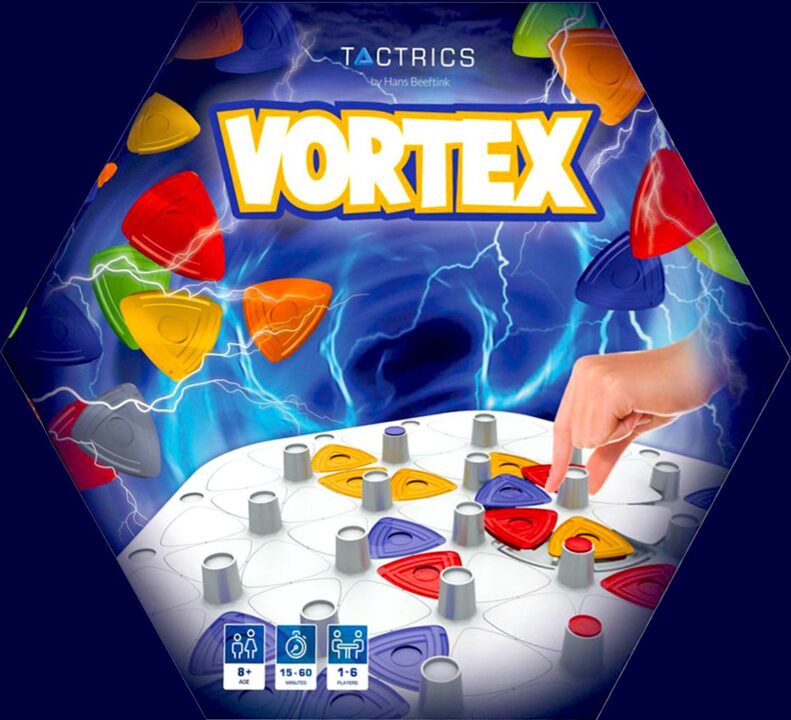
Welcome to my review of Vortex! This game promised wild spins, bold art, and a tabletop tornado of chaos. Read on to see if this swirling pile of components and color is worth squeezing onto your already stuffed board game shelf.
How It Plays
Setting up
First, place the Vortex board in the middle of the table. Hand out a set of colored pieces to each player. Shuffle the special cards, put them in a pile, and make sure everyone has room to spin things without whacking someone’s drink over. Trust me, I learned this the hard way.
Gameplay
On your turn, you spin the central board. Where it stops will affect your options (and sometimes your dignity). Players try to move their pieces to goal spots or collect points by clever moving and not-so-clever luck. Play a card if you want to shake things up, or if you just want to annoy your friends.
Winning the game
The first player to score the target number of points (check the rules, your version might vary) wins. Or, if you’re playing with people like me, the real winner is whoever still has friends left after the last spin.
Want to know more? Read our extensive strategy guide for Vortex.
How Vortex Spins Player Interaction and Game Mechanics
Let’s talk about how Vortex works, because the first thing I learned after opening the box is that everyone starts plotting against each other before the first round is even over. Vortex is a tile-laying game with a super neat twist: the board literally spins, making your careful planning go sideways (sometimes in a good way, sometimes…not so much). Players take turns placing tiles to build paths, score points, and block their sneaky friends from grabbing easy wins. The spinning isn’t just a gimmick. Each rotation can set traps or save you from disaster. It’s like playing chess, but someone keeps turning the board when you’re not looking. My friend Matt spent ten minutes planning a move, only for someone to spin the vortex and leave him whimpering. Classic Matt.
The interaction in Vortex is not just you versus the game, but you versus everyone else’s best-laid plans. You can block, steal, or just ruin someone’s day by sending the vortex on a wild ride. What I enjoy most is that even when things go wrong, there’s still always a way to mess with another player’s strategy. And nobody can brood for long, because you’ll get your turn to spin that vortex. It’s a delightfully chaotic recipe for laughter and trash talk, but everyone stays engaged thanks to the simple actions and fast turns. You always feel like you have a shot—even when the vortex has spun you into next week.
Next up, let’s see how Vortex balances that spinning chaos with good old-fashioned strategy vs. luck—because trust me, it’s not all random mayhem.
How Much Skill Does Vortex Need? Strategy vs Luck
I went into Vortex holding my breath. Not because I’d eaten too much bean chili beforehand (okay, maybe a little), but because I never know what balance of skill to expect from a game that looks this wild. Let’s just say, after three playthroughs with my regular crew (the ones who keep causing chips to fly off the table in excitement), I got my answer.
In Vortex, your choices matter. You decide when to chase points, when to block your neighbor, and when to risk moving onto that one dangerous spot. But, here’s the twist: every now and then, Lady Luck crashes through the door like a dog tracking in mud. Those random vortex spins? Sometimes you laugh, sometimes you want to cry, and sometimes you just want to throw the board out the window and move to Belgium.
There’s room for clever planning. If you see your opponent about to score, you can sabotage their next turn—if you play your cards right. But then the board shifts, and your genius move looks, well, less genius. Don’t get me wrong—it isn’t all bad. That bit of chaos keeps things silly and makes sure no one takes it too seriously. But if you crave the precise strategies of chess, Vortex will tie your brain in knots… then set those knots on fire.
So, is Vortex more brains or more luck? It’s a tie, with luck doing the extra dance moves. Next up, let’s see if Vortex stays fresh or turns into last week’s leftovers with replay value and variability!
How Vortex Brings Replay Value and Keeps Things Fresh
Replay value is what separates a one-hit-wonder from a classic in my board game closet. You know the feeling: you play a game once, it’s fun, but after the second round you start eyeing Netflix. Lucky for everyone, Vortex doesn’t fall into that trap. It keeps calling us back for more (like a cat sitting on a game board—impossible to ignore and always in the way).
Every session with Vortex feels different. That’s because the board changes its layout thanks to the spinny (technical term) vortex center mechanic. Players end up scrambled and scattered, and the strategy you used last time probably won’t save you this time. Plus, the game comes with several scenario cards and modular components, meaning you can set up new challenges every session. Even Uncle Bob, who once won by pure fluke, can’t rely on the same cheap trick twice.
If you’re a fan of games that grow with your group, you’ll love the house rule potential. We invented our own “Sudden Vortex” rule one night, and it led to utter chaos and a lot of loud laughter. It’s also got enough randomness that you’ll rarely see two identical games, but not so much that it feels like you’re just tossing dice at a wall and seeing what sticks.
If you can break away from the table long enough, next up I’ll spill the beans on whether Vortex looks as good as it plays—or if it’s just another game with art only a mother could love.
Component Quality and Artwork in Vortex: Plastic Fantastic or Cardboard Catastrophe?
Let’s get one thing straight: if a game’s pieces look and feel like the leftovers from a failed arts-and-crafts night, I am out. Luckily, Vortex takes its bits and boards pretty seriously. Right out of the box, the thing looks great. The board is chunky but not clunky—sturdy enough to survive a couple of coffee spills (don’t ask), and it spins in a very satisfying way. I’m not saying it became a fidget toy, but let’s just say ‘my turn’ sometimes took longer than required. The play pieces feel solid. No cardboard standees that flop over if you breathe—the tokens and markers have a premium feel, and the colors are bold enough that nobody on Team Colorblind gets left behind.
The artwork is, well, vortex-y. You get this cosmic swirling vibe with a splash of retro sci-fi, and it honestly makes staring at the board between moves an oddly pleasant experience. The iconography is clear (a miracle!), so I wasn’t stuck checking the rulebook every three minutes. Cards could be thicker, but unless you’re shuffling them with a chainsaw, they’ll hold up fine.
Honestly, I have seen far worse at higher prices. Does Vortex give you miniatures that weigh as much as a small dog? No. But it gives you quality for your buck and a table presence that turns heads, not stomachs.
Would I recommend Vortex based on its component quality and artwork? Absolutely. Unless you only buy games for their box smell, Vortex is a winner in this department.
Conclusion
So, that’s my wild ride with Vortex. If you like a spinning board, strategy mixed with a dash too much chaos, and top-notch art, it can be a blast. The components are sturdy and the game keeps you guessing, but luck sometimes grabs the wheel and sends your big plans down the drain. If you want pure strategy, look elsewhere, but otherwise, Vortex is worth a try for game night. This wraps up my review—now I’m off to glue that spinner back on.