
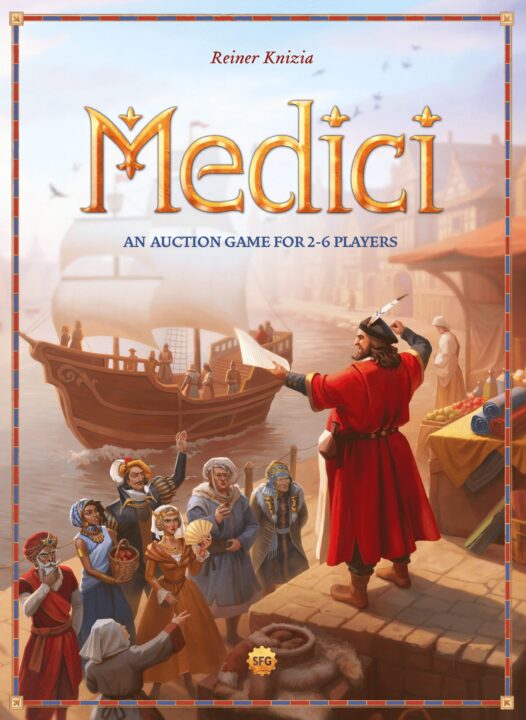
This review looks at Medici, a sharp auction game where every card can make you richer, poorer, or loudly question your friends’ maths. The game rewards timing and reading the table, though a bad card draw can still leave you staring at an empty wallet. Its 45–60 minute play time keeps things moving, and changing player habits give it good replay value.
How It Plays
Medici is an auction game about buying valuable goods, filling your ship, and making the most money. It sounds calm, but someone will always bid one coin too many. Usually me.
Setting up
Give each player a set amount of money and place the goods cards nearby. The game lasts three rounds. Shuffle the cards, then choose a dealer for the first round.
Gameplay
The dealer reveals one to three goods cards, one at a time. Players bid for the whole group, not for single cards. The highest bidder pays the bank, takes the cards, and loads them onto their ship. Players can pass, but they may bid again when a new lot appears. At the end of each round, players score their ship’s goods and collect income from majorities and empty spaces.
Winning the game
After three rounds, players add their money and final scores. The player with the most cash wins. Medici rewards sharp bidding and good timing, so spending every coin early can leave you feeling like a pirate with no boat.
Want to know more? Read our extensive strategy guide for Medici.
Medici Auction System: Sharp Choices on the Dock
One Ship, Many Problems
The auction in Medici looks simple. Players reveal goods cards from ship, then take turns bidding for the whole lot. That last part matters. You cannot pick one nice spice card and leave the ugly fish behind. You buy everything, including the fish nobody wanted. Each round turns a boat into a test of nerve, maths, and table talk. I have watched friends become loud traders after one player flashed a purse and shouted, “You will never beat that!” It was not their finest moment, but it made game sing.
Reading the Table
Your choice starts before anyone names a price. You study the cards and guess what each rival needs. A player chasing grain may overpay for a bundle. Another with cash can wait and punish greed. Medici rewards this read, but it never makes the choice comfy. A lot might fill your hold but block a better buy later. A rich lot may score well yet empty your cash before the final round. I often bid one coin too high, then spent the next round pretending it was all part of my plan.
Bidding Without Regret
The move means passing. A pass keeps money and signals little, which can make rivals fear a plan. Yet passing feels awful when a rival grabs a bargain. The auction shifts with count. With people, a bid carries weight. With five, the price can leap as fights for space. That change keeps Medici fresh, though players may feel lost until they see how card values work. A aid would help explain this without slowing the game. Next, the Luck versus skill balance section will show whether cards help your plans or kick them downstairs.
Medici Luck Versus Skill: Can Smart Play Win?
Cards Bring the Chance
Medici gives luck a seat at the table, but it does not hand luck the keys. Each round reveals goods from a shuffled deck, so players may hope for cargo or stare at low value cards. That swing creates tension without turning the game into bingo. We enjoyed the reveal, even when deck served us a lunch of grain and salt.
Skill Finds the Edges
Skill matters because players control how they value imperfect information. You see your own cards, track goods already shown, and watch which colors vanish from the deck. Those clues help you judge what may still appear. You cannot know the future, yet you can build a range of outcomes. I often made safer estimates after spotting a pattern, while my friend Pete kept chasing one dream haul and paid for it with a face that looked like a tax bill.
The luck feels fair because every player faces the fog. No secret power lets one person bend the deck, and no random event wipes out a strong plan. A poor card can still serve as a sale if you value its weight, its place in the round, and the needs of your cash pile. That last part matters. Medici rewards calm math more often than guessing, though a lucky final reveal can still make someone shout, ‘I planned that!’ when everyone knows they absolutely did not. Next, we will look at Pacing and game length, where Medici must prove its rounds can finish before our snacks vanish.
Medici Board Game: Pacing and Game Length
A Quick Market, A Tight Clock
Medici moves with a brisk rhythm that keeps the table awake. Each round starts with a market, and players quickly decide when to push for one more card. That simple loop gives the game a neat heartbeat. Nobody sits waiting for a twenty-minute rules speech, which means Medici gets moving before someone can check their phone for “important” cat videos.
Short Rounds, Big Decisions
A full game usually takes around 45 to 60 minutes with four or five players, depending on how fast your group counts money and argues over shiny goods. With three, Medici feels leaner and can finish in about half an hour. The short length makes it easy to play twice in one evening, and that second game often feels sharper because everyone remembers the first game’s painful bargain. Still, five players create the best buzz, while two players can make the market feel a bit sleepy and less wild.
Table Talk Without Traffic Jams
The pacing also benefits from simple turns. You reveal goods, name a price, and watch the table react. Turns rarely drag unless someone treats every coin like a family heirloom. Even then, the group soon learns to keep things rolling. The game does not pad its runtime with extra rules or busywork, and I respect that more than my wallet respects a long game night.
Next up, we’ll test Medici with different groups to see whether its replay value survives beyond our usual crew of loud bargain goblins and sleepy snack thieves.
Medici Replay Value: How It Works With Different Groups
Replay value often depends less on the box and more on the people around your table. Medici proves that. With friends, I keep seeing new table habits appear. One friend plays safe and collects sets. Another treats every auction like a stage show, tossing out bids to make us sweat. A third watches everyone, then grabs the card nobody valued. This mix keeps each session from feeling stale.
With Casual Players
With casual players, Medici works as a game that teaches itself quickly. New players may miss chances, but they soon learn the table’s rhythm. They can bid lightly, chase useful cargo, or enjoy watching sharks panic over purple. The rules stay light enough for mixed groups, so nobody needs a long lecture. That makes it easy to bring Medici back when your group wants something simple.
With Serious Players
With serious players, replay value comes from reading the room rather than learning rules. The same cards can create choices when players change their habits. A group may produce calm auctions, while another pushes prices into silly territory. I enjoy switching seats because it changes who feels confident. Playing with three people feels personal. At six, I must track more plans. Both counts feel distinct.
When the Shine Fades
Medici does not offer endless variety. The cards, player count, and simple goal stay familiar after several plays. If your group wants fresh powers, secret goals, or wild board changes, this game may feel plain. I still find that its short length helps. A rematch fits after a close loss, and a new group can make old cards feel fresh again. I recommend Medici for groups that enjoy sharp choices, friendly rivalry, and replaying a trusted classic.
Conclusion
This concludes my review of Medici. Luck shapes the cards, but smart bidding and good timing matter more. The pacing stays brisk, and each group brings new tricks to the table. It can feel a bit mean when a bad draw wrecks your plan, but that sting rarely lasts long. If you enjoy tense auctions, simple rules, and watching friends pretend they have a master plan, Medici is well worth a look.