
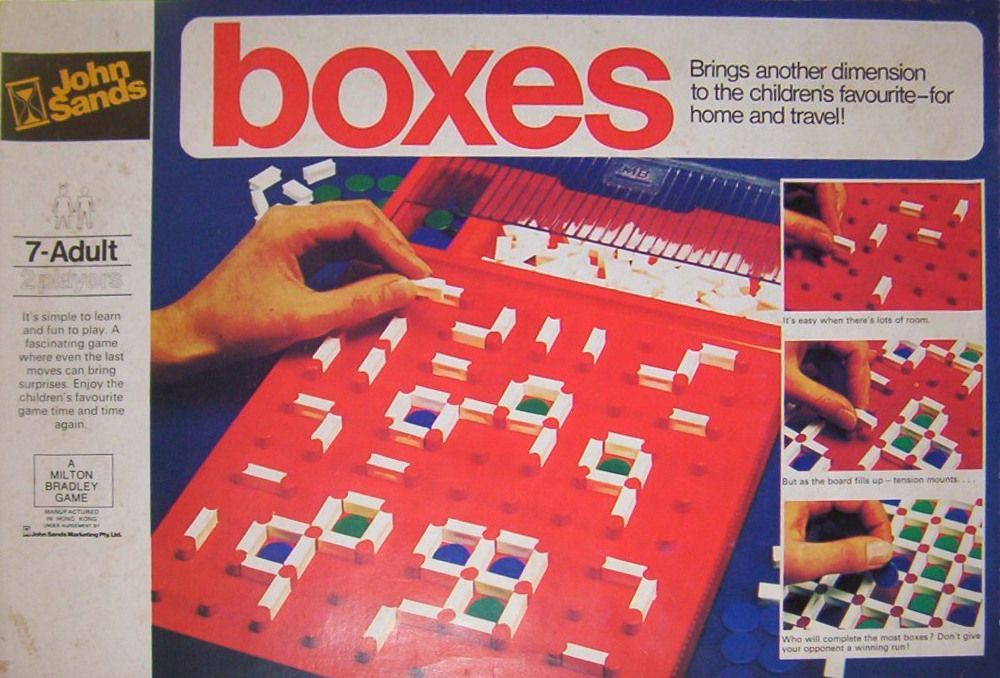
If you love games where you can outsmart your friends, get a bit competitive, and maybe even start a friendly grudge, this review is for you. I spent a bunch of weekends putting Boxes through its paces with my board gaming crew, and let me tell you, we now have new trust issues. But was it worth it? Grab a snack and find out if this simple-looking game is a real winner or just another box on your shelf.
How It Plays
Setting Up
Place the Boxes board in the middle of the table. Give each player a set of colored markers or pens. That’s it. No crazy setup steps, and you won’t need a PhD in game science to get started.
Gameplay
Players take turns drawing one line between two dots. You can go horizontally or vertically, but not diagonally—this isn’t extreme tic-tac-toe. If you complete a square (that’s a box), you claim it by marking it with your color. After finishing a box, you get an extra turn. Keep your eyes open—one wrong line and your buddy might swipe two boxes in a row.
Winning the Game
The game ends when every possible box is claimed. Count up everyone’s boxes. Whoever has the most boxes wins bragging rights—and possibly a snack from the loser. Simple, right?
Want to know more? Read our extensive strategy guide for Boxes.
Simple Rules, Quick Start: Learning Boxes
I’ve played a lot of games in my life—some with rulebooks thicker than my grandma’s knitting guide, and others that you can learn while eating pizza and yelling at your friends. Boxes falls into the second group, thank goodness. You only need a few minutes to learn the basics, and even less if you ignore my buddy Greg’s habit of dramatically over-explaining his every move. The core idea is simple: each turn, draw a line to connect two dots. If you finish a square—bam, that’s a box, and it’s yours. The player with the most boxes at the end wins. That’s about it!
The rulebook is short, with clear language and handy pictures—not those weird, confusing diagrams that look like Rorschach tests. When my niece (she’s ten and beats me at everything) picked up Boxes, she understood the game before I finished setting up snacks. No special cards jumping out mid-game, no dice rolling across the floor, and absolutely no rule-lawyering from Greg (for once).
If you play only occasionally or with kids, you’ll love how fast you get started. I will warn you, though: if you come from games that reward deep strategic planning, Boxes feels a bit light in that area. But for a fast, fun, and frustration-free start, it’s hard to beat. It’s a solid option for a weeknight, a rainy afternoon, or when your brain’s just not up for mental gymnastics.
Next up, let’s find out just how cutthroat Boxes can get when it’s every player for themselves…
How Cutthroat Can Boxes Get? Player Interaction and the Battle for Victory
Picture this: I’m at the table with three of my most competitive friends, and we’re all staring at the Boxes board like it owes us money. This game looks so innocent at first—a bunch of little squares begging to be claimed. But as soon as everyone gets the rules (which, trust me, happens fast), it turns into a silent war. The main way you interact in Boxes is by drawing lines and blocking others from completing their own boxes. It’s part chess, part cold-hearted sabotage. You can almost hear the collective groan when someone realizes you just cut off their plan in one bold move.
One time, my buddy Dave tried to play nice and avoid rivalry. By round three, he learned the hard way—this game eats the friendly alive. If you’re not thinking two steps ahead and watching everyone else’s moves, you’ll find yourself boxed out (yep, pun intended). The level of competition ramps up more with each turn, especially when the board starts to fill. That’s when alliances are whispered, threats are made, and friendships… well, they survive, but only just.
Boxes rewards active engagement. If you look away, even for a second, someone will scoop up your would-be points. The thrill comes from snatching victory when nobody saw it coming, or blocking your friend out of a sweet combo. It’s satisfying, but it can get tense, too. If you hate direct competition, you might want to sit this one out. But if you like a healthy bit of rivalry, Boxes is perfect.
Next up, let’s talk about luck versus strategy in Boxes—because if you think you can blame the dice, you’re in for a surprise!
Luck vs. Strategy: Who Really Wins in Boxes?
Okay, let’s get the elephant out of the room—does Boxes make you rely on your brain power, or are you rolling dice and crossing your fingers like you’re trying to win the lottery?
Boxes is all about tactical choices. You face decisions almost every turn. Placement, blocking, and predicting what sneaky moves your friends will make next—this stuff really matters. Sure, there’s a bit of randomness in what options you might have each round, but it’s not the kind of game where luck calls the shots. Strategy wins out 90% of the time. If you lose, don’t blame the game—blame Sam, who convinced you to give him that corner spot (I’ll never live that down).
The only real luck comes when someone makes a total blunder and hands you a win. So, yes, luck is there, but more in the form of ‘other people’s mistakes’ than the draw of a card. If you like planning your way to victory and turning your friends’ errors into your own glory, Boxes is sweet. Randomness takes a back seat, and you actually get rewarded for outsmarting your tablemates. Overall, I love how fair the game feels, which is a breath of fresh air compared to some other games where the dice have it in for me.
Now, let’s turn our eyes—and hands—to the next topic: just how shiny, chunky, and fun the boxes in Boxes are to hold and look at. You’re gonna want to see this.
Boxes: Can You Judge This Game By Its Cover?
Let me get straight to it – Boxes shows up at the table looking sharp. You get a stack of sturdy, chunky cardboard squares that feel almost fancy. No wimpy bendy stuff here! I’ve spilled my drink on a piece (I blame my cat, okay?), and it survived with nothing but a slight coffee scent. The box itself is strong enough to handle wild game night chaos, even if someone launches it across the room in a fit of boxy defeat. Not that I did that. Twice.
The design is humble, but not boring. Each box tile has clear, bold lines and numbers. The color scheme is simple, so you don’t get eye ache after staring at the board for an hour. I mean, I love glitter and dragons as much as the next gamer, but minimalism is king here. There’s also a nice weight to the tiles, which makes that satisfying clack sound when you slam one down to block your buddy’s move. That’s what board games are all about, right?
One nitpick: the box’s insert is so-so. If you like your pieces neatly arranged, bring your own baggies. But if you’re like me and just dump everything in, you won’t mind at all.
So, do I recommend Boxes based on looks and feel? Absolutely! If you need a game that’s easy on the eyes and tough on wear and tear, Boxes checks the, well…boxes!
Conclusion
It’s easy enough for anyone to learn in five minutes, but there’s a sneaky layer of strategy under the surface. If you enjoy competitive games where you can outsmart your buddies (and maybe lose a friend or two), Boxes is a winner. The sturdy pieces and clean look help too, even if the box insert is a bit pointless. You won’t find wild swings of luck here—just outwitting and some very dramatic pencil lines. If you want a fast, clever game that still makes you sweat, give Boxes a shot. That wraps up my review—see you next game night!