
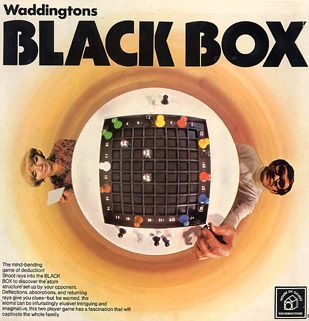
Welcome to my latest review, where I tackle a classic that’s as brain-bending as staring at a magic-eye poster after three cups of coffee. Yes, I’m talking about the one and only Black Box—a game that promises pure deduction, frantic peg-placing, and more accusations than a reality TV reunion. If you’re tired of games where luck flips the table (literally, if my cousin Greg is involved), then read on, because this might be your new favorite test of wits. Ready? Let’s see if your brain is up for the challenge.
How It Plays
Setting Up
Grab the Black Box board, a handful of white and black pegs, and decide who will play as the “Scientist” and who will be the “Operator.” The Operator secretly places a few atoms (black pegs) inside the box grid, hidden from the Scientist. Try not to knock the table and reveal any secrets like I did last time!
Gameplay
The Scientist sends “rays” (white pegs) into the box, guessing which hole will hit or miss an atom. The Operator gives clues based on whether the ray is absorbed, deflected, or passes through, placing pegs accordingly. There’s a lot of squinting, thinking, and doubting your life choices. You repeat this until you’re either a deduction genius or your brain starts to leak out your ears.
Winning the Game
The Scientist wins if they correctly figure out the hidden atom locations within a set number of guesses. The fewer guesses used, the smarter (and more smug) you feel. If the Scientist runs out of guesses, the Operator wins and gets bragging rights until next game night. Simple, tense, and totally addictive.
Want to know more? Read our extensive strategy guide for Black Box.
The Rules of Black Box: Simple or Sneaky?
If you like games where the rules don’t cause a family meltdown, Black Box might just be your jam. When I cracked open the box, I didn’t see a rulebook the size of a law textbook—always a great start! The basics: One person hides a bunch of little balls (atoms, really, but I call them balls because I’m a board game rebel) inside the grid, and everyone else tries to work out where they are by sending in lasers. Simple, right?
Well, yes and no. The laser thing sounds like a plot from a spy movie, but you actually just say a number and wait for a response. The instructions explain the bounce, reflect, and hit results pretty well. I picked it up in about ten minutes, which is honestly quicker than I learned how to tie my shoes. Some folks struggled remembering exactly how the lasers react, but we sorted it out with a cheat sheet (or as I call it, the ‘Laser Life Saver’).
There’s hardly any set up, and you don’t need to keep checking the rules after round one—unless you drop a coffee on the manual, which happened in my case. Helpful tip: Print a backup if you invite clumsy friends. Black Box is not one of those games where people bicker about what the rules actually mean. If you can count to nine and can say ‘bounce’ without giggling, you’re ready to play.
Next up, let’s see if Black Box creates mind-blowing tension or if it’ll have you yawning between turns like my cat at a philosophy lecture.
How Black Box Messes With Your Mind—and Your Friendships
If you want a game that twists your brain and your trust in others, Black Box is just what the doctor ordered (if the doctor is a villain with a monocle).
Here’s how it goes: one person—the evil mastermind—hides marbles in their secret Black Box. The other players, who I like to call the ‘Guessing Geniuses,’ fire imaginary lasers into the box by picking coordinates. Based on where the lasers come out (or don’t), they try to figure out where those sneaky marbles hide.
I spent half the night as the mastermind, smirking while my pals argued over quantum marble placement like they were prepping for a NASA launch. The group buzzed with theories, wild guesses, and sometimes, crys of “How can you be so sure, Karen?” Spoiler: Karen is never sure. But that’s the fun—every turn makes you second-guess everything, and sometimes old grudges resurface. (Thanks, Black Box, for reminding Dan about the Uno incident of 2017.)
Black Box doesn’t have flashy pieces or miniatures, but its player interaction is top-notch. The guessers bounce ideas around, sometimes teaming up, sometimes going rogue (I’m looking at you, Greg). As the mastermind, you get to play poker face, which led to several rounds of everyone thinking I’d cracked under pressure. Jokes on them—I’m always like that.
If you like deduction and stirring up heated debates about geometry and laser physics (without actually knowing either), Black Box is your jam. Next up, let’s see if the pieces are as sturdy as our long-lasting grudges—time to talk Component quality and board layout!
Black Box: Component Quality and Board Layout Up Close
Let’s talk about the stuff you’re actually touching in Black Box. First up, the titular box itself: it’s not velvet-lined or anything, but it’s a sturdy bit of plastic. You can’t crush it with your bare hands (my friend Kyle tried—he’s wild), so it’ll last through dozens of game nights. The marbles or pegs used for marking guesses? They’re just the right size to flick at your brother when he’s not looking, but also big enough that you won’t drop them on the floor and watch them roll under the sofa, never to return. That’s a real plus in my book.
The board layout in Black Box is also about as straightforward as it gets. You’ve got a grid of numbered squares, cleanly printed and easy to read even if you forgot your glasses again (like I did last week). There’s no garish color scheme—just bold lines and numbers. Honestly, it reminds me a bit of a minimalist chessboard, only less intimidating. There’s a tray or area for those pegs off to one side. Everything has its place, so setup takes less time than it takes me to explain the rules to my grandma (and that’s saying something).
Component-wise, Black Box doesn’t scream luxury, but it also doesn’t feel cheap. It’s built for play, not for display on a fancy shelf next to your collection of rare, gold-plated meeples. The pieces fit in the box with room to spare, so you’re not fighting to close the lid after a session. Next, we’ll crack open the most important part: can you play again and again without getting bored out of your mind, and is there more to strategy than just wild guessing? Stay tuned!
How Much Brain-Burning Fun Can You Squeeze from Black Box?
When it comes to replay value, Black Box did not gather dust on my game shelf. This one comes out again and again – especially when you have a house full of would-be Sherlocks or sneaky evil geniuses. Each game is fresh since the hidden molecule set-up changes every round. That makes my dream of memorizing some magic solution totally useless! The variety keeps things spicy. Even after many games, I haven’t seen the same setup twice. Sort of.
Strategy-wise, Black Box makes you work. You get to ask clever questions with your “rays” to figure out what’s hiding in the box. There is no luck here—just pure logic and deduction. Weirdly, you feel like a genius when you solve it, and like an absolute potato when you mess it up. It rewards careful thinking, thoughtful guessing, and a little bit of swagger. The satisfaction of solving a tough puzzle isn’t just luck—it’s earned.
But be warned: if you play with a group that hates losing (like my cousin Rachel, who once flipped a table during Yahtzee), tempers might flare. The game walks a fine line between being smart and being maddening. Still, if you love puzzly, thinky games with infinite replay, Black Box is a solid pick. I say, buy it, play it, and prepare for your brain to thank—and curse—you.
Conclusion
So there you have it, folks—my brain hurts in the best way after playing Black Box. If you love pure deduction with zero luck messing up your master plans, this is a must-have puzzler. The rules are simple, the quality is solid, and every game gets the group debating like we’re all Sherlock Holmes. Sure, it doesn’t win beauty contests, but it also won’t break or leave you confused. Strategy runs deep, and there’s loads of replay value. That’s the end of my review—now I need a nap and maybe less suspicious friends!