
How To Play: *Star
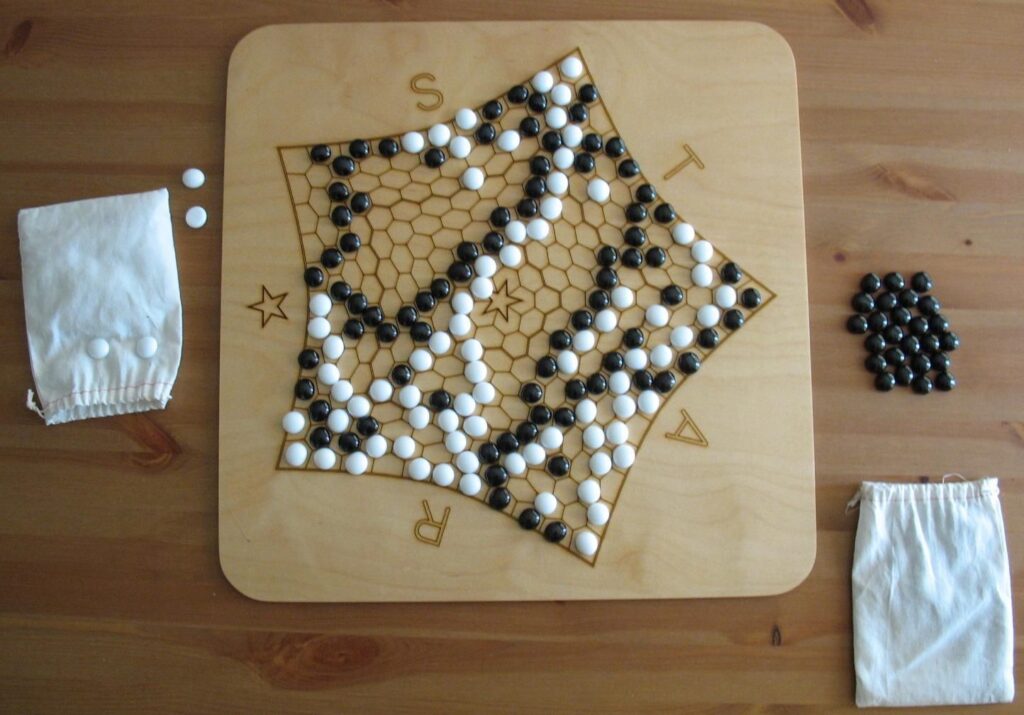
Learn *Star’s stone placement, connected groups, edge ownership and scoring, including the fewer-stars adjustment.
*Star is a two-player connection game. Place stones to claim edge cells while joining your groups together: isolated groups cost points in the final calculation.
Setup and your turn
Use the five-sided *Star board and two colours of stones. The smaller boards marked within the tournament board use the same rules. Players alternate placing one stone on an empty cell. Stones stay where placed. The central star-shaped bridge is unavailable for placement, but both colours may use it to connect.
Groups, edge ownership and scoring
A connected group containing at least two edge cells is a “star”. It owns its occupied edge cells and enclosed edge cells not owned by another star. At the end:
- Score one point per owned edge cell.
- Award one extra point to the player owning at least three corner cells.
- Compare each player’s number of separate stars. Add twice the difference to the player with fewer stars, and subtract the same amount from the other player.
Finish when the board is full or both players agree further play cannot increase either score. The higher score wins. The tournament board’s combined score is 51, preventing a draw.
Read the publisher’s diagrams before counting enclosed cells.
Rulebook and teaching tips
Before playing, have everyone explain one sample turn and the end condition. Refer to the original diagrams together when a placement or scoring question arises. Mark the relevant page so the whole group can check it during play.
Read our *Star review for a closer look at the game.