
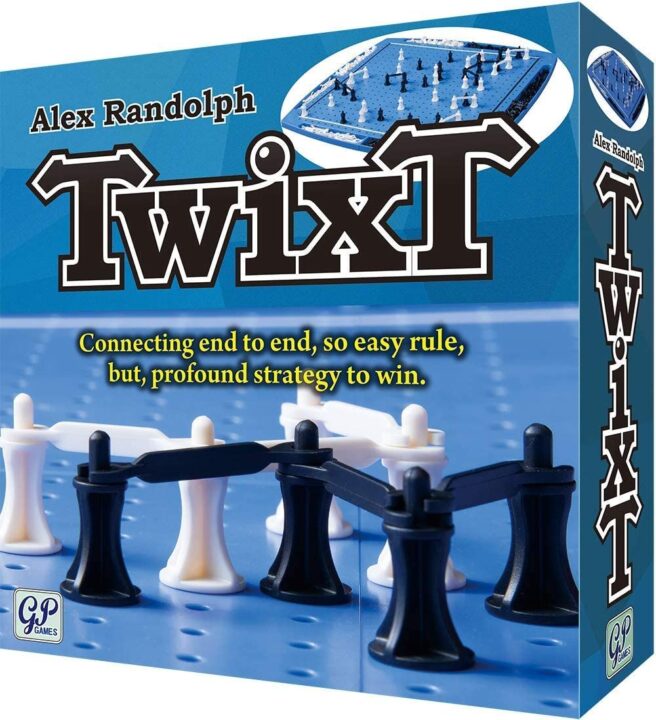
Put away those dice and forget about lucky rolls—this review is all about pure brainpower and sneaky tactics. If you want a game that will test friendships and melt your neurons (in a good way), you’re in the right place. After subjecting my pals to an embarrassing number of matches, I’m ready to spill the beans on what makes this classic stand out—and where it might wobble a bit.
How It Plays
Setting up
Lay out the Twixt board between both players so the pegs line up. Each player grabs a baggie of their colored pegs and bridges. You pick a side to connect—either top to bottom or left to right. Easy peasy.
Gameplay
Players take turns placing one peg anywhere on their side of the board, aiming to connect their two sides. After placing a peg, you can add bridges to your own pegs as long as they make a knight’s move (like the chess horsey). Bridges can’t cross, so sometimes you gotta get creative or block your friend (a.k.a. future ex-friend if it gets heated).
Winning the game
The first player to make an unbroken chain of bridges connecting their two sides wins. If you pull it off, do a little victory dance—but not in your opponent’s face, unless they started it.
Want to know more? Read our extensive strategy guide for Twixt.
Gameplay Mechanics and Strategy Depth in TWIXT
If you’ve never played TWIXT before, let me paint you a quick picture. There’s a board, two colors of pegs, a mess of plastic bridges, and a race to connect your side to the opposite edge before your rival does. It sounds simple enough, until you realize how many different ways there are to mess up, sabotage, or surprise your friends. The rules are so easy to learn that I taught my cousin’s goldfish in three minutes (okay, he just stared blankly, but still—fast to teach!).
The real meat of TWIXT lies in its strategy. There’s zero luck. Not an ounce. It’s just you, your opponent, and a whole lot of: “wait, why did I put my peg there?” Every turn, you place a peg, then try to link to another one of your pegs using those delightful bridges, but bridges can’t cross, so it gets spicy fast. Defensive play can be just as strong as offense, especially when you’re blocking your opponent while quietly building your own path. All my games ended with someone crying ‘betrayal!’—and not always in jest.
Unlike games that rely on dice or card draws, TWIXT is all about planning ahead and paying attention. You’ve got to watch every move, because sneaky paths can pop up out of nowhere. There’s a lot of back-and-forth and bluffing, and you can get seriously lost in thought (I once forgot my cup of tea until it was stone cold—TWIXT did that!).
Since every move matters, TWIXT keeps you on your toes, making each match a true duel of wits. Up next, I’ll share whether those bridges and pegs are a joy to touch or a plastic nightmare—get ready for some hands-on component talk!
Component Quality and Board Design in Twixt: More Than Just Plastic Pegs
Let’s get one thing straight: Twixt isn’t one of those fancy, overproduced Kickstarter games with a box that could double as coffee table furniture. Nope, Twixt keeps it old school, and honestly, I kind of respect that.
The board itself is basic, but it does its job—solid plastic, won’t warp if you spill a drink (unless it’s something wild like lava). The holes are evenly spaced, making peg placement easy, which is oddly satisfying. The pegs and connectors feel like they could survive a minor apocalypse. One of my more destructive friends ‘accidentally’ knocked the board off the table and, to everyone’s shock, not a single piece broke. I even think the dog tried to eat a connector once, but the connector won.
Design-wise, it’s simple, clean, and there’s no clutter or distractions from the game itself. I do wish there was a splash of color—everything is so gray and black, it feels like playing in a mathematician’s office. But hey, it makes the completed network of bridges look pretty impressive. Just don’t expect Instagrammable components unless your feed is just photos of things that are rectangles.
Ready to find out if Twixt is welcoming to new players, or if it’s as easy to learn as quantum physics? Onward, to learning curve and accessibility!
How Hard is it to Learn Twixt? (Spoiler: Not as Tough as it Looks!)
Let’s be real: when someone first plopped Twixt down in front of me, I thought I’d need a PhD in advanced spaghetti-bridge engineering just to play. But after one round (and only a minor meltdown), I realized Twixt is actually super accessible once you get past the intimidating pegs and links. It’s basically connect-the-dots for adults—but with way more bragging rights at stake.
The rules are simple: you place pegs, you connect them, and you try to, well, twixt your way across the board before your opponent. There’s no stack of confusing cards or outrageous dice rolls. You don’t have to memorize a thick rulebook or look up weird terminology (I’m looking at you, Agricola). I’ve taught this to my little niece and my chess-obsessed uncle. Both picked it up in less than ten minutes. Now, whether you master Twixt? That’s another story. The strategies run deeper than the Mariana Trench, and it takes a bunch of plays to spot all the sneaky moves and traps.
If you want a game with low barriers, clear rules, but a high skill ceiling, Twixt checks the boxes.
Next up, let’s see if Twixt keeps you coming back for more, or if it’s a one-hit wonder when it comes to replay value and player showdowns!
Endless Fencing: Twixt’s Replay Value and Riveting Rivalries
Let’s get down to the real reason I’ve played Twixt more times than my local bakery runs out of bear claws: It never gets old! Every session feels like a fresh duel. No two games of Twixt look or feel the same. Sure, the board starts out empty, but once those posts and links start popping up, every match becomes a tug-of-war between my brain cells and my opponent’s.
There’s no sneaky dice rolling or card shuffling here. It’s just you against another human (or a very clever cat, if you’re desperate). You can spot patterns, trick your friends, and try out weird new opening moves. I once even tried a wild “let’s go only left” strategy, and lost horribly. Still, I learned something, which is the beauty of this game—your brain grows with each round.
Player interaction is off the charts in Twixt. Every time someone blocks your perfect line, you’ll hear gasps, groans, and sometimes words you can’t print. It’s always tense, but never mean. No kingmaking or ganging up—just pure two-person rivalry. Communication is basically trash talk and the occasional apology for a savage move. And honestly, I wouldn’t have it any other way.
So, do you need another game all about outsmarting your friends? For its variety and face-to-face drama, I say: absolutely! Twixt keeps me coming back, even when my victory dance clears the room.
Conclusion
If you want a game where skill crushes luck and silent grudges form over hexagonal pegs, Twixt might just be your new go-to. The simple but sturdy pieces mean you’ll actually finish the game instead of chasing lost pegs under the table. It’s easy to learn but sneaky-deep, so both new and seasoned players can enjoy it. My only real gripe is that it turns your brain into mashed potatoes if you’re not paying attention, but I’d rather that than lose to someone who just rolls higher. If tactial battles and friendly rivalry are your thing, Twixt is worth a spot on your shelf. That wraps up my review—now if you’ll excuse me, I have to reclaim my Twixt crown!