
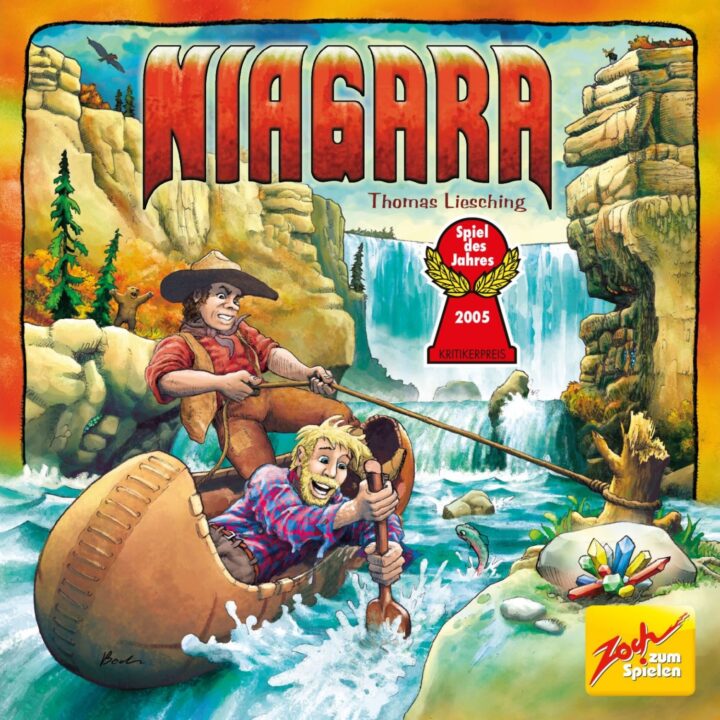
This review looks at a wild race down a moving river, where careful timing, sneaky blocking, and a little luck decide who grabs the shiny gems. The shifting river creates fresh trouble every turn, while the race keeps everyone watching, plotting, and blaming the nearest boat. Its clever parts and strong replay value make it stand out, though luck can still splash your best plans right off the board.
How It Plays
Setting up
Place the river tiles between the two banks, with the waterfall at the far end. Put the gems on the shore spaces, then give each player two canoes and a matching set of paddle cards.
Gameplay
Each round, everyone secretly picks one paddle card and reveals it together. Move your canoes along the river by the number on your card. The river then flows, pushing the water tiles toward the falls. You can collect gems from the shore, carry them in your canoes, or steal them from a rival if your canoe catches theirs. Choose carefully—waterfall trips are bad for both boats and weekends.
Winning the game
Bring four gems safely back to your home shore. You win with four different gems, four gems of one colour, or three of one colour plus one other. The first player to meet one of these sets wins.
Want to know more? Read our extensive strategy guide for Niagara.
Niagara River Movement and Timing: Steering Your Canoe
Timing on the Niagara River
In Niagara, the river is not a painted board waiting for your plans. It moves. Each round, players secretly choose a paddle card, then reveal them together. The card sets how far your canoe travels, while the river tiles slide toward the falls. That tiny shift makes every trip feel like a race against a wet clock. I have watched a friend grin after drawing a card, only to find the water had carried the gem he wanted over the edge.
Timing matters more than speed. A long move can look clever, but it may leave your canoe beside Niagara’s hungry waterfall. A short move can seem dull, yet it may place you next to a gem or a rival canoe. You also need to judge the current: some river pieces move farther than others, and the board changes after every turn. Usually, the loudest player sails into the falls. Classic.
The best part is planning while the river keeps changing. You can map a route, but Niagara nudges that map out of shape. Save strong cards for key moments, watch rival canoes, and check which tiles will move. A surprise current can still wreck a neat plan, though. I enjoy that risk because it creates stories, not just points. Niagara makes each paddle card feel like a cliffhanger. Next comes Strategy versus luck, where I’ll judge how fair those surprises feel.
Strategy Versus Luck in Niagara
Planning Around the Unknown
Each round, we choose a paddle card in secret. That choice sets our canoe’s movement, while the river shifts around us. The best plans work like good weather reports: useful, but never perfect.
Luck enters when several players want the same route, or when a movement sends a canoe toward danger. Still, Niagara rarely feels cruel. A weak card can become a clever shield, letting me block a rival or wait beside a waterfall. The game rewards patience more than heroic guessing, which saved my pride.
However, luck can still kick the table leg when two canoes reveal matching cards. Nobody controls every river change, so perfect plans often wobble. I watched Sam map a rescue turn, then lose time because another player nudged the current first. He called it strategy. We called it Tuesday.
Reading the Table
Good play comes from reading people, not just cards. I track who has already spent a strong movement, who wants a gem, and who keeps smiling far too much. That last clue may not appear in the rulebook, yet it works. Niagara turns table talk into data, though quiet players can gain an edge.
That balance makes the game tense without making it feel rigged. Skilled players usually create better choices, but chance keeps the race close. I blamed the river. The river accepted no apology.
Next, Gem collecting and player interaction will show how trading and cheeky blocking can turn river trouble into treasure.
Niagara Gem Collecting and Player Interaction Review
In Niagara, collecting gems looks simple: reach a shore, grab treasure, paddle home. But each gem sparks debate. Do I take the safe yellow gem, or chase the rare red one before another player gets it?
Gem Choices Create Table Talk
Player interaction gives Niagara its bite. You cannot collect only what sits nearby. Rivals block handy landing spots, claim a gem you wanted, or force a new plan with one clever move. Niagara does not let players attack boats directly. Instead, the shared board makes every choice easy to watch. You see who wants blue. You see who has room to carry it. That knowledge keeps the table lively.
Gems, Grudges, and Funny Betrayals
The best moments come when someone takes a valuable gem, then finds the route home blocked. A rival may sit on the safest shore, smiling like a cardboard shark. You can bluff or warn them, though Niagara has no formal trading rule. In my games, we formed alliances, then broke them later. Nobody stayed angry; the betrayal felt funny, not cruel.
Still, gem collecting can punish quiet players. If two people gang up on the leader, that player may lose a turn through no fault of their own. This happened in our game, and the unlucky captain nearly threw a canoe at me. Niagara works best with friends who enjoy blocking. If your group hates take-that play, the race may feel sharp. The next section will cover Components, rules, and replay value, showing what keeps Niagara fresh after the first haul.
Niagara Board Game Components, Rules, and Replay Value
Niagara arrives with a bright board, chunky wooden canoes, colourful gems, player discs, and handy water gauge. The gems look like tiny sweets, though nobody should eat them. The cardboard feels sturdy, and our copy survived several crowded game nights without curling corners. The plastic pieces fit neatly in the box, which matters when storage becomes a battle of its own.
Rules That Teach Themselves
The rulebook explains setup clearly, with pictures that help more than a wall of tiny text. On the first play, we taught everyone in about five minutes. Each turn uses a secret card, then players resolve their choices in order. The steps feel simple, but the full table still needs attention. A missed rule can cause a groan, yet we corrected it fast.
Replay Value After The First Game
Replay value matters because Niagara stays fresh without piling on extra rules. Each group creates a mood. The game works best with three or four people, where table talk stays lively. With two, it feels quieter, while five can stretch evening.
Still, the box offers variety for repeat plays, and the rules stay light enough for younger players to join. I like how Niagara resets between games; nobody needs a spreadsheet or a shovel. The parts feel the guide works, and the design earns shelf space. I recommend Niagara for families and groups seeking a repeatable game.
Conclusion
That concludes my review of Niagara. The moving river looks great and makes every turn feel risky, while the gem hunt gives players clear goals without drowning the game in rules. Luck can spoil a plan now and then, but smart card play usually keeps you in the fight. The components, simple rules, and changing river make Niagara easy to teach and fun to bring back to the table. It may frustrate players who hate surprise setbacks, but most groups will enjoy its bright look and sneaky choices. I happily recommend it for families and casual gamers who want a tense, funny race with a wet backside.