
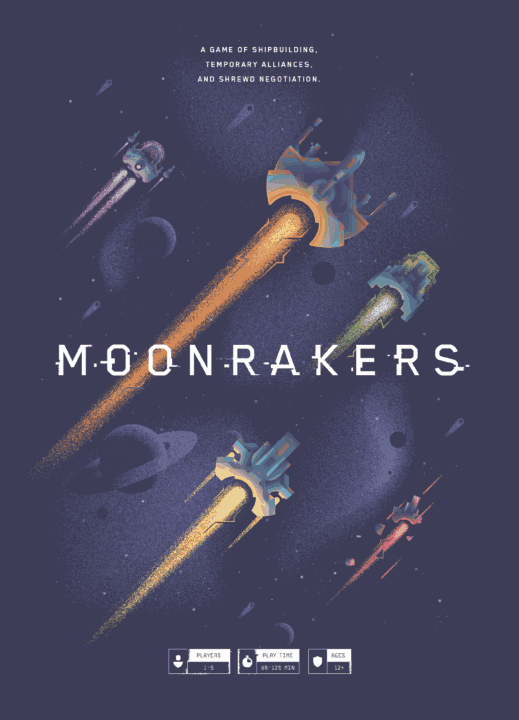
If you’re like me and think sci-fi should involve less physics and more space pirates with questionable motives, then welcome! This is my review of a game where betrayal is as common as running out of snacks—Moonrakers. Read on to see if this game lives up to its intergalactic hype—or if it gets lost in the vacuum.
How It Plays
Setting up
First, toss the big Moonrakers board in the middle of the table. Everyone gets their own little ship with a basic deck of cards, a couple of credits, and a personal goals card. Shuffle the contract cards and stack them by the board. Put the upgrades and crew cards nearby. Make sure everyone has snacks, because you’ll be here a while.
Gameplay
On your turn, you’ll try to tackle contracts by yourself or team up with your “trustworthy” friends. You play cards from your hand to meet contract needs—like thrusters, shields, and reactors. Most of my games ended up being “let’s bargain like we’re at a yard sale” sessions because nobody wants to fail a contract on their own. You’re also improving your deck with new cards, upgrading your ship, and maybe double-crossing your buddy for an extra point.
Players take turns, and the table often turns into a fast-paced negotiation circus. One minute you’re allies, the next you’re left cleaning space toilets alone.
Winning the game
First person to 10 prestige points wins and is crowned Chief Moonraker. Points come from completing contracts, personal objectives, and, if you’re playing like my friend Steve, slicing deals so good it should be illegal. But if you go for glory too quick, the table will see to it that you crash and burn. So, pace yourself and trust no one—not even Steve.
Want to know more? Read our extensive strategy guide for Moonrakers.
Deck-Building & Card Combos: The Heartbeat of Moonrakers
Deck-building. It sounds like something you might do at Home Depot, but in the board game world, it means crafting the perfect hand of cards to crush your opponents or sometimes just mess them up a little. Moonrakers puts you in charge of your own rag-tag space crew and ship, letting you pick and choose the cards you want in your hand. Imagine building your dream crew, but these folks come with lasers and shields instead of awkward small talk.
I’ve played my fair share of deck-builders, from Dominion to Clank!, but Moonrakers gives you a special twist. Here, every mission feels like a mini-puzzle, and those decks you build are your toolbox. The joy of stringing together card combos can flip a near-loss into a jaw-dropping win. They didn’t.)
The upgrades you buy add flavor to your deck and your ship. It’s fun playing the auction game with yourself: Do I need that extra reactor, or would my ego survive skipping it? The best bit? There’s very little random draw pain. Bad luck happens, but it rarely feels like the game is punching you in the face. Strategy and planning usually win out.
But beware—go overboard and you end up with a deck that only draws coffee breaks instead of laser fire. Next up, we’ll see how Moonrakers forces you to trust your sneakiest friend through player negotiation and alliances. Stay tuned for some wild stories!
How Moonrakers Turns Negotiation and Alliances Into a Space Soap Opera
Picture this: I’m at the table playing Moonrakers, and for a second, I forget I’m not on some intergalactic version of The Apprentice. Negotiation and alliances in this game turn a quiet night into a festival of weird promises, hasty backstabs, and desperate peace offers. Moonrakers doesn’t mess around when it comes to group dynamics. You literally can’t get by on your own—you have to team up with your rivals if you want to pull off the juiciest contracts. And let me tell you, nothing tests friendships quite like arguing over hazard payouts and reward splits while someone else tries to quietly grab the best loot.
The magic happens when you realize that every negotiation is a fine balancing act. If you’re too greedy, people will freeze you out. If you’re too generous, you’ll end up with scraps while someone else sails to victory. Moonrakers forces you to read the room constantly. My friend Ben, for example, is a master at pretending to be helpful before swooping in and grabbing all the credits. I should have seen it coming. Lesson learned: trust no one, but smile anyway.
Sometimes, the best deals come from the most unlikely alliances. Desperation brings out heartfelt speeches, sneaky deals, and moments where I honestly wondered if I was still playing a board game. If you thrive on drama and banter, Moonrakers serves it up. Next up—let’s blast off from the drama for a hot minute and talk about whether Moonrakers is easy on the eyes or just another space eyesore!
Moonrakers Board Game: Stunning Artwork and Premium Components
I always judge a board game by its cover, and Moonrakers absolutely nails its first impression. The moment you lift the lid, it’s like opening a treasure chest. The box looks so fancy that my cat gave it a respectful nod and sat on it for ten minutes. High praise from her, believe me.
Let’s get to the artwork. Every card bursts with slick sci-fi vibes — think gritty space bars, shiny ships, and mysterious crewmates who probably have a side hustle selling asteroid insurance. The art really sets the mood for a motley crew of space mercenaries. My friend Julie spent five minutes just admiring the ships before even reading the rules. Who needs instructions when your spaceship card looks ready to launch?
Components? Top notch. The custom metal coins have found their way into my “useful for bribing friends” pile. They feel weighty and cool, unlike those limp paper coins you find in some other games. The chunky plastic pieces and thick boards could probably survive a small meteor strike (or at least a spilled drink — thanks, Dave). Even the rulebook sports a surprisingly premium feel. If you ever feel the urge to cosplay as a Moonraker, just walk around holding the box — instant credibility.
Honestly, the production quality here makes you feel like you’re piloting a luxury starship instead of just arguing over missions in my cramped living room. But don’t worry, I’m not blinded by all the shiny bits — next up, let’s see if Moonrakers strikes the right balance between luck and skill, or if fate is really just the biggest player at the table.
Luck vs Skill: Outwitting Fate in Moonrakers
Let’s talk about that always-spicy topic: luck versus skill. If you’ve played as many games with my crew as I have (shoutout to Greg, the eternal dice jinx), you’ll know we can sniff out a luck-fest from a mile away. Lucky for us (pun intended), Moonrakers tries to strike a solid balance—but does it actually pull it off?
For starters, this isn’t one of those games where a single lucky card ruins everyone’s master plan. Sure, there’s some randomness in drawing cards and event outcomes. But, most of the time, a smart player can still outpace their luckless moments. Building the right deck and forming deals with the right people (or, if you’re me, with the wrong people who immediately betray you) takes real skill. Decisions matter. And so does reading the room.
What I didn’t love: mission rewards can be a little swingy, and sometimes you’ll feel like the game has dealt you a dud hand. But even when my hand was a pile of space junk, some creative negotiating and combo-building made for satisfying saves. The best part is, with the negotiation angle, you can sometimes balance out a streak of bad luck by convincing someone else to help you—often at the cost of their better judgment (Sorry, Greg.)
If you hate losing “just because of bad luck,” Moonrakers might just win you over. It’s not totally free from chance, but skill and smart play rule the cosmos here. I recommend it—just, maybe, don’t play it with Greg.
Conclusion
Alright, so that wraps up my journey with Moonrakers. It’s a shiny, fun romp through space with deck building, wild negotiations, and art that makes your table look epic. Sure, the game needs the right group or those negotiations could just fizzle. Also, luck pops up now and then, but skill keeps smart players ahead most of the time. If you want spacey scheming with cards and laughs, Moonrakers is a good pick. Just keep an eye on your so-called allies…