
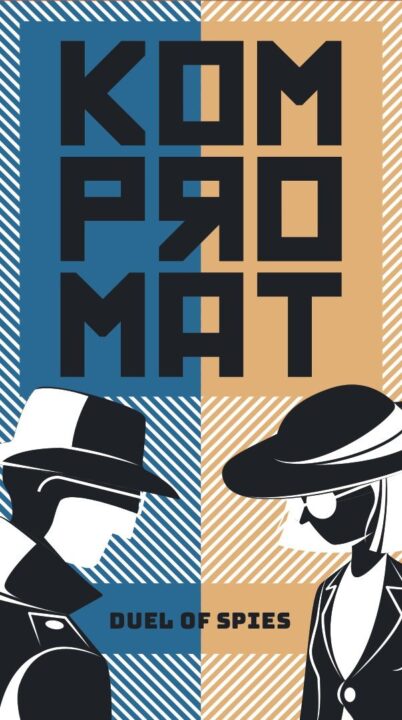
Is Kompromat the card game that finally lets me live out my wildest secret agent dreams without breaking a sweat, or will it make my poker face crack wider than a cheap sunglasses frame? Welcome to my review, where I stack the deck, test my spy skills, and try not to lose friends over a few heated bluffs. Spoiler: I’ve played this one more than a couple times (sorry, Ben, for tricking you into a bust… twice). Let’s see if this game deserves a spot in your game night briefcase, or if you’re better off sticking to paper-rock-scissors when you need to decide who’s getting the snacks.
How It Plays
Setting Up
Start by putting the mission cards in a neat pile between you and your rival spy. Each player grabs their own set of action cards and picks a color. Grab a pencil and score pad, because you’ll need to keep track of all the sneaky moves you make. Deal out some intel tokens and set the danger cards within reach. Now you’re ready to go undercover.
Gameplay
On your turn, pick a mission to fight over. Both players play action cards, aiming to get as close to 21 as possible without going bust – yes, it’s blackjack, but with way more suspicious glances and sweaty palms. You can keep hitting (drawing cards), try to bluff your way into making your opponent back down, or quit before you blow your cover. If both of you go bust, the mission card gets tossed. Special action cards can shake things up, so use them when your opponent least expects it.
Winning the Game
The game ends when the mission pile runs out or one agent reaches the danger limit. Points from completed missions and intel tokens get counted up. Whoever has the most points is crowned the sneakiest spy of all. Just don’t gloat too much—it’s very unspylike.
Want to know more? Read our extensive strategy guide for Kompromat.
Blackjack with a Secret Agenda: How Kompromat Flips 21 on Its Head
Kompromat takes the classic blackjack formula, throws it in a trench coat, and tells it to act sneaky. If you grew up watching your uncle Larry bust at the casino, you’ll know the tension of hitting or standing at 16. But in Kompromat, the pressure isn’t from chips on a green felt–it’s from the eyes of the person sitting right across the table, pretending not to care while you sweat buckets over your next draw.
Here’s what’s wild: You play cards face up in your tableau, still trying to get as close as possible to 21 without busting. Fine, basic stuff. But each round, you’re actually fighting over missions by comparing your blackjack lineup to your rival’s. If you win, you claim the mission–but if you bust, you lose out, and sometimes you even lose points. It hurts. My friend Emma busted three times in a row and nearly flipped the table. (We’re still on good terms. I think.)
The other twist is that you get special agent powers for certain missions, so you might risk a bust for a juicy reward. It’s not just about playing the odds, it’s about reading your opponent, betting on your own luck, and sometimes just screaming internally.
This blackjack twist cranks the mind games to 11, and every card you draw is a little panic attack. But if you think the cards are stressful, just wait until you hear what happens when players start bluffing–which is up next!
Tension and Bluffing: Staring Down the Enemy in Kompromat
If you have ever played poker with your grandma and she bluffed you out of your pocket money, you will feel right at home with Kompromat. This game has tension and bluffing baked into its core, and believe me, it delivers some white-knuckle standoffs. Just ask my friend Greg, who thought he could read my poker face—let’s just say he owes me three sodas and eternal shame.
Kompromat makes every move a calculated gamble. Instead of knowing exactly what you’re up against, you only see your opponent’s public cards and a whole load of unreadable intentions. The game practically begs you to bluff. Do you push your luck and grab a risky mission? Or do you play it safe and hope the other spy falls on their own sword? Half the fun comes from watching your opponent sweat under your vaguely threatening gaze.
Where Kompromat really shines is in the non-stop tension between players. You have to think about your next play, but also what your rival might pull, and who will break first.
Up next, I’ll spill the beans on Kompromat’s artwork, components, and overall theme—let’s see if the box is as sneaky as the gameplay!
KomproMat: Slick Artwork, Solid Components, and Espionage Galore
I have to admit, opening Kompromat felt like opening a spy dossier. The artwork hits that perfect spot between comic-book cool and Cold War grit. Every card gives off secret agent vibes—lots of shadowy figures, mysterious envelopes, and enough sunglasses to make you question your own eyesight. It looks like they raided every spy movie ever made and picked out only the best bits. Even my friend Todd, who notices nothing (he once played a whole game of Azul upside down), kept flipping cards over just to check out the art.
The components in Kompromat are simple but sturdy. You don’t get a jumbled mess—just crisp cards, a neat scoreboard, and those little tokens that somehow always end up under my chair. The cards shuffle well and don’t feel cheap. In fact, after four games, they have no dings, which, in our house, is a minor miracle. I won’t say the game screams luxury, but it’s well above the usual small-box suspects. If you’re the kind of person who panics over flimsy cards, rest easy here.
The theme of Kompromat ties it all together. You really do feel sneaky, swapping out your usual poker face for something more MI6. Somehow, the mix of bluffing, scoring, and that “will they or won’t they bust?” tension pulls you right into a shadowy duel of wits. It’s easy to imagine yourself with a fake passport and a trench coat… instead of sweatpants and half a bag of chips.
But just how much of Kompromat is skill, and how much is pure chance? Well, let’s put on our risk-analysis glasses and sneak into the next section to find out!
Luck Versus Skill: Is Kompromat a Game for Spies or Dice Rollers?
Alright, let’s talk about the big debate: is Kompromat more James Bond or more “spin the wheel and hope for the best”? I’ve played Kompromat more times than I’ve watched reruns of old spy movies (which is a lot, trust me). It’s the kind of game where your clever plans can either work out beautifully or crash and burn in spectacular fashion, sometimes thanks to Lady Luck herself.
The main mechanic, pulling cards blackjack-style up to 21, does introduce a truckload of luck. I’ve had matches where my friend Steve drew three cards and hit 21 perfectly, while my carefully considered move ended in a spectacular bust. I could hear the Mission Impossible theme playing, but it was my carefully drawn plans, not the game, that self-destructed. But here’s the twist: Kompromat lets you choose when to stop drawing, so there’s skill in knowing when to push and when to hold back. If you’ve ever lost a poker hand because you went for “just one more card,” you know what I mean.
The bluffing part does let you outplay your friends. If you can make your opponent sweat or play conservative by pretending you’ve got the perfect hand, skill shines through. Still, luck sometimes spoils your best spy moves. I’d say it’s about 60% luck and 40% skill. I wish it was the other way around, but that’s the nature of Kompromat’s design.
So, do I recommend Kompromat? If you like a good mind game with some luck thrown in, go for it! If you hate luck messing up your heist, this one won’t be a license to thrill, but it’s a fun mission while it lasts.
Conclusion
Kompromat wraps up as a clever little duel for wannabe spies with quick reflexes and poker faces that would make my grandma proud. The art and theme nail that cool espionage vibe, and the card quality stands up to dramatic, table-slapping stand-offs. Sure, luck plays a sneaky role – if you hate busted missions and wild swings, Kompromat might ruffle your tuxedo. But if you love tense moments, risky bluffs, and getting inside your opponent’s head, this game will give you a great evening of tense fun. This wraps up my review. If you like quick two-player card games with a side of sabotage, Kompromat will fit right in your collection.