
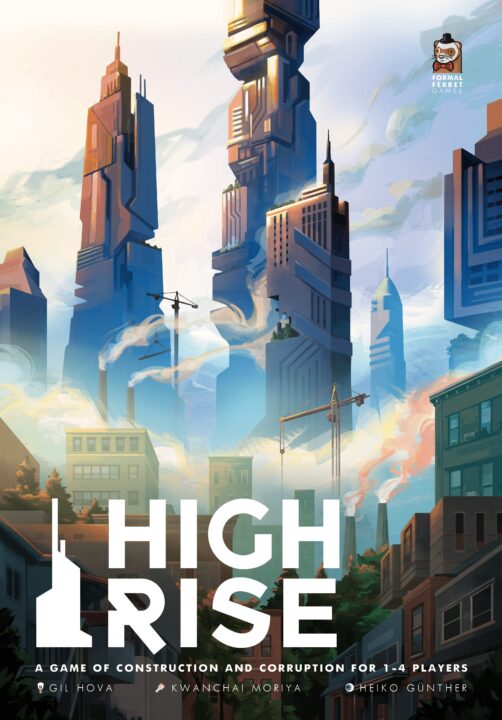
Ever had the urge to build a skyscraper, but your bank account says otherwise? Well, you’re in luck—sort of. Welcome to my review of High Rise, a game where you get to stack floors and bribe city officials without risking your real-life rent money. I’ve played this one with my board game crew, and let me tell you, it’s as much about outsmarting your pals as it is about claiming the tallest cardboard tower in the skyline. Let’s see if this city-builder soars or topples before the final round!
How It Plays
Setting up
Lay out the city board in the middle of your table. Give each player their starting tokens and building floors. Place the corruption tokens nearby, within evil arm’s reach. Shuffle the bonus tiles and place them in their spots, pretending you remember what any of them do. Pick your favorite color, or just grab whatever your friend didn’t take.
Gameplay
On your turn, move your pawn forward to any open space—no tiptoeing or backtracking! Collect resources, grab permits, or build up your tower of dreams. As you cruise along, you’ll feel the sweet, sweet temptation of corruption, which helps you get more stuff but bites you later. You’ll fight (nicely) over plots, try to out-build your rival, and maybe bribe the city council if you want to play dirty. Turns go round and round until everyone decides to actually finish the lap and quit hoarding.
Winning the game
After set rounds, everyone counts up the points from their glorious skyscrapers, bonuses, and whatever shady business they managed to sneak by. Corruption gets deducted. The builder with the highest score is crowned the king (or queen) of High Rise, and the rest of us threaten a rematch.
Want to know more? Read our extensive strategy guide for High Rise.
Game Flow and Player Interaction in High Rise: Skyscrapers and Side-Eye
Now, let me tell you, “High Rise” keeps everyone on their toes from start to finish. It’s like a real estate dance party where each player is trying to build the tallest skyscraper, but you can’t ignore the other wild architects across the table. My buddy Steve, who usually just snacks and zones out, suddenly became a city-planning genius when he figured out he could skip ahead and ruin my entire building plan. Rude, Steve. Just rude.
The game moves along a time track system—think “Tokaido” but with more elevators and less zen. You leapfrog ahead to take a juicy action, but if you leave your pawn stuck in the dust too long, you might miss a key opportunity. Turns out, trying to be smart with your moves isn’t as easy as it sounds—one hasty decision and you’re the proud owner of the city’s shortest, most embarrassing tower. Everyone else seems to pile on the victory points like it’s Black Friday for urban development.
Player interaction is top-notch here. You’re not just competing for resources, you’re fighting for prime building spots, prestige, and even the “least evil” reputation (the corruption track is a hilarious twist—who knew city planning was so… shady?). Even quiet players turn into real estate moguls after a round or two, plotting each other’s downfall. No hiding in the background here; you feel every decision, every betrayal, every time your dream skyscraper crumbles because someone else nabbed the spot you wanted.
But how much of your win comes from clever play, and how much is just dumb luck? Let’s roll into the next section: Strategy versus luck balance—grab your dice and your dreams!
Strategy vs Luck: Who Really Rules the Skyscrapers in High Rise?
If you’ve ever wanted to test your city-building smarts against your friends, High Rise is the game to do it. But let’s talk about the real question—does skill actually win, or does luck just drop a crane on your plans?
From what I’ve seen (and, trust me, I’ve seen a few friendships wobble on the edge of a skyscraper), High Rise really leans toward strategic play. Most decisions feel meaty: you’re weighing what action to take, who you’ll annoy the most, and how to plot the tallest, flashiest building possible. Sure, the turn order can make you mutter under your breath when someone swoops in and snags your perfect spot, but most of the game feels like a proper mental tug-of-war. There are lots of ways to rack up points, and you have to read your friends’ intentions like you’re playing poker at an architects’ convention.
Luck does pop up in a few spots—those event tiles aren’t going to draw themselves, and sometimes the random order flips your clever plan upside down. But I never felt like random chance was playing the game for me. If you lose, you probably made a few shoddy choices with your zoning, not because the dice (there aren’t any, for the record!) betrayed you. The punishment for taking corrupt actions can also sneak up on you, and sometimes a lucky event tile lets you dodge that just in time, but on the whole, brains beat luck here.
Now, before you get too high on strategy, let’s talk about what you’ll be holding in your hands and staring at for two hours—the components and the artwork!
High Rise Shines (Mostly) on the Table: Component and Artwork Quality
They say you shouldn’t judge a book by its cover, but let’s be real—I always peek at the box before picking what to play next. High Rise makes a pretty loud first impression. You get a chunky, colorful board with a cityscape that looks—if I squint—like the skyline of a city run by ambitious toddlers. The artwork is bold and a bit quirky, which actually fits the game’s personality. No stiff, boring city planners here!
Let’s talk bits and bobs. The cardboard tokens in High Rise have a solid, satisfying feel. Is it childish? Yes. Is it fun? Also yes. The plastic building floors are well-made, and I’ve yet to break one, even after an accidental elbow knocked over a whole city block. My only gripe: the modular board pieces sometimes shift around, especially when you get excited and wave your arms. A player mat or a bit of sticky tack could fix that, but still, it’s a thing.
Cards are easy to read, icons make sense (after a quick rulebook check), and the bright color palette means you won’t fall asleep between turns. There’s enough visual pop to keep everyone paying attention, but it won’t give you a headache. If you’ve ever played a beige eurogame and wished for more, well, color, High Rise has your back.
But is it pretty enough to keep coming back? Well, let’s talk about replayability and game length before you start building emotional skyscrapers.
Replayability and Game Length in High Rise – Will You Want Another Round?
Alright, let’s get into the meat and potatoes of playing High Rise again and again. To start, this game’s replay factor surprised me—and not just because my friend Becky always chooses purple and somehow dominates with it (still not over that).
Every session of High Rise throws a new city layout at you. The tiles change, and you never quite get the same skyline twice. The game encourages you to try new strategies too. Want to go all-in on corruption and see if you can squeak a win? Give it a shot. Prefer to play squeaky clean and stack points like an overachiever? That works as well. The choices you make, and the possible building combos, keep things fresh every time.
Game length is in a sweet spot for me. I clocked most plays at about 90 minutes with three or four players. That’s right in my Goldilocks zone—long enough to feel satisfying but short enough that my in-laws don’t wander off and start playing on their phones. The game also scales pretty well. With two players, it runs faster, but you lose a bit of the “elbow bumping” competition for buildings, which is half the fun.
On the replayability front, High Rise holds up better than most city-builders I’ve played. If you like city-building, strategic choices, and a bit of friendly chaos, it’s easy to get back to the table.
So, do I recommend it? You bet your bonus penthouse I do. Unless you hate cities, buildings, or fun, High Rise deserves a spot on your shelf!
Conclusion
Well, folks, that’s my review of High Rise. If you like building cities, outsmarting your friends, and a table full of plastic floors, this one’s a true winner. High Rise is smart, interactive, and rewards good planning with every turn—just don’t try to build a real skyscraper out of those chunky components or you’ll end up with an angry cat and a broken game! The art is bold, the replayability is top notch, and it wraps up in a sweet spot of playtime. It’s not perfect—some building tiles are cooler than others and the table footprint is more New York than New Jersey. But overall, it’s a clever challenge that’s more brains than luck. If you find city-building fun and like a bit of friendly rivalry, High Rise is well worth a spot on your shelf.
That’s it for this review. Now if you’ll excuse me, I’ve got another round to win—my buddy still thinks he can outbuild me (he can’t).