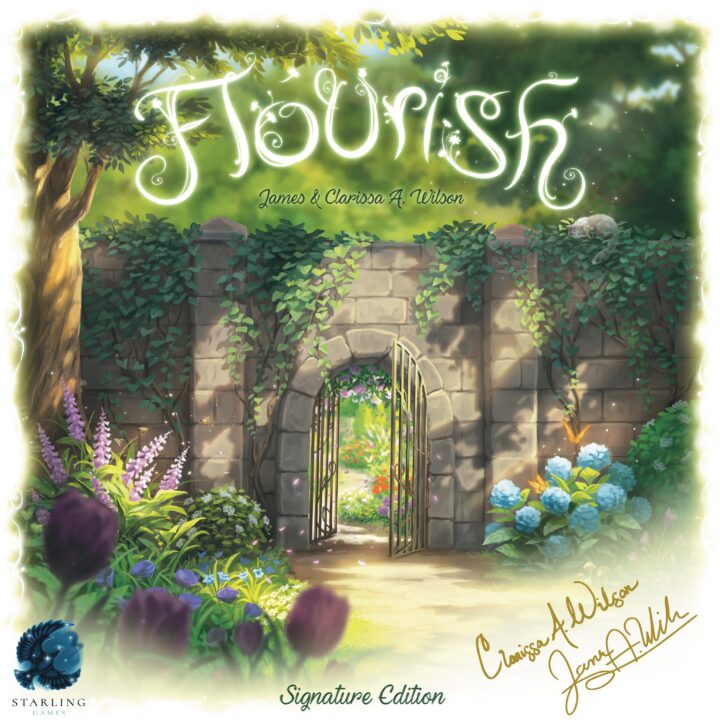

Welcome to my review of Flourish! If you love gorgeous cards, sneaky strategy, and passing stuff to friends while secretly sabotaging them, then hey, you might be in the right garden. I played this one with my usual bunch, including my neighbor (who thinks he’s a plant), and we laughed, plotted, and argued over the best flower combos for a solid hour. But not all was rosy—there are some prickly bits too. Let’s see if this one will bloom for you or wilt on your shelf!
How It Plays
Setting Up
First, everyone grabs a lovely garden board and a matching set of tokens. Shuffle the deck of plant and feature cards like you mean it. Deal everyone a hand of six cards, and stack the rest in the middle as the draw pile. Scatter out the pretty scoring tokens, and you’re good to grow.
Gameplay
On your turn, you pick a card to add to your budding garden. But here’s the twist: you have to pass cards to your neighbors, so you can’t hoard all the good stuff. Every round, you swap, plant, and sometimes sigh as your best card floats away. There’s also scoring tokens for special features and flowering combos—so plan ahead, or at least try to look like you do.
Winning the Game
After three rounds of sweating over your garden and plotting the ultimate petunia strategy, it’s time for scoring. Add up points for beautiful flower beds, matching features, and any sneaky bonuses you scored. Whoever has the most points is crowned the grand champion of garden glory! The prize is bragging rights and maybe a polite round of applause.
Want to know more? Read our extensive strategy guide for Flourish.
Stunning Gardens on Your Tabletop: Artwork and Component Quality in Flourish
If there’s one thing that makes Flourish stand out in my game shelf, it’s the artwork. Every time I lay the cards out, my friends ooh and ahh like we’ve stumbled into a botanical garden rather than my crumb-covered dining table. The colors are vibrant and the illustrations are packed with detail. I sometimes catch myself daydreaming about stealing plant ideas from the cards, as if my real garden isn’t already a battlefield of weeds.
Speaking of cards, they feel just right. Not too flimsy and not so thick they fight back when I shuffle. The finish has this slightly glossy shine, which makes the pictures pop and resists the odd coffee ring. I’m not saying you should spill your drink on Flourish, but if you do, you might stand a chance at a quick wipe-up. (Trust me, this is not just theory.)
The box insert fits everything neatly, with space for expansions. That’s a relief! I’ve owned board games where the insert is basically a badly folded piece of paper pretending to be useful. Flourish does it better by actually keeping things organized, even after a night of rowdy gaming. The wooden tokens are chunky and satisfying, like little garden gnomes without the weird faces. No splinters, no weird paint smells—just smooth and pleasant bits to handle.
Overall, Flourish sets the bar for beauty and build. Next up, get ready for the weeds and wild growth of game mechanics and strategy!
Flourish: A Garden of Mechanics and Mind Games
When I first played Flourish, I thought it would be a peaceful flower stroll. Boy, was I wrong. This game hides some sneaky depth under its lovely petals. The main mechanic is set collection mixed with card drafting. Each round, you pick which gorgeous card will grow in your garden and which ones you’ll gift to your neighbors. It’s like that weird feeling when you bake cookies for friends but secretly wish you could eat them all yourself.
Flourish keeps you on your toes because you always have to plan for now and the future. You score points each round with what’s already planted, but your big payoff comes at the game’s end—so you have to balance short-term wins and long-term glory. My friends and I spent a lot of time just staring at our hands, trying to guess what masterpieces everyone else was plotting. I felt like Sherlock Holmes, but with daisies instead of dead bodies.
The game offers plenty of strategy. There are objectives that push you to try different combos, and bonus cards let you chase clever tactics. Sometimes, though, the cards just don’t go your way, which can make strategy feel a bit like gardening in the middle of a tornado. Still, if you like games where you have to think ahead, Flourish serves up a satisfying brain workout—without leaving dirt under your nails.
But enough about personal scheming! Next, I’ll get into Flourish’s player interaction and how the game keeps (or ruins) friendships. Grab some gloves; it’s about to get thorny.
Player Interaction and Balance in Flourish
Let’s talk about how Flourish gets folks talking—or at least muttering under their breath. One thing my friends and I noticed is that this game walks a delicate line between neighborly help and sly sabotage. You’re not just building your own flowery wonderland; you’re slipping cards to the players beside you. Sometimes you’re a generous garden gnome, sometimes you’re the neighbor who plants a weed.
Flourish makes you watch what your opponents collect, especially since your left and right pals end up getting cards from you every turn. So, you might pass that not-so-great rose bush to your buddy, but only if you can live with them getting a few precious points. On the other hand, hand management becomes a whole sport—figuring out when to be kind and when to sprinkle a little mischief. In my group, this led to a lot of table talk, fake symapthy, and a few hearty laughs when someone realized too late just what they’d been gifted.
Balance-wise, Flourish feels fair. No strategy is totally dominant and the shared scoring with neighbors means you stay invested in everyone’s garden. If you hate games where one bad move ruins it for you, you’ll like that Flourish lets you recover. It never feels like luck alone decides who wins, and that’s a huge plus for me.
Next time, I’ll share if this flower bed keeps growing or wilts on the second play, and who’ll love playing it with you!
Flourish: Replay Value and Who Will Love This Game
I’ll be honest—Flourish keeps calling me back like that one song you never get tired of. The clever mix of private card building (“no peeking at my garden!”) and community scoring makes each play feel fresh. Even after a handful of games, my group kept saying things like, “Okay, but next round, I’m going to outdo you all with pure flower power.”
The replay value stays high because you can score in a bunch of ways. Do you hoard the prettiest garden, or do you risk helping your neighbors with the cards you pass? There’s also a solo mode, which is nice if your friends ghost you or they’re just kind of ruthless and you need a break. Plus, unique scoring cards and different garden strategies mean you won’t see the same outcome twice. Even my friend Roberta, who famously hates repeating games, didn’t complain once. (If you knew Roberta, this would blow your mind.)
Now, who’s going to love Flourish? If you like a mix of light strategy, easy rules, and a little bit of “Ha! Gotcha” moments, it’s for you. It’s a smooth fit for families and for casual game nights. Super heavy gamers may find it a bit too gentle, but it’s a solid pick if you just wanna relax and grow a beautiful garden.
Verdict: I’d recommend Flourish to anyone who wants a breezy, charming game that doesn’t overstay its welcome. It’s a green thumbs-up from me!
Conclusion
Alright, that’s a wrap on my review of Flourish! After many rounds with friends (and a questionable amount of flower puns), I can say this game is a blooming good time for folks who like clever card play, gorgeous gardens, and a fair dose of friendly rivalry. The artwork makes your table pop, the components hold up to shuffling and spills, and the gameplay keeps things interesting without needing a PhD in botany. Sure, it’s not for those craving deep strategy or huge combos, as luck can sneak in like a dandelion in your prize-winning rose bed. But if you want a pleasant, replayable, and well-balanced card game for family nights or casual groups, Flourish is worth planting in your collection. Now, if you’ll excuse me, I have some suspiciously competitive friends eying my violets. Thanks for reading—see you at the next review!