
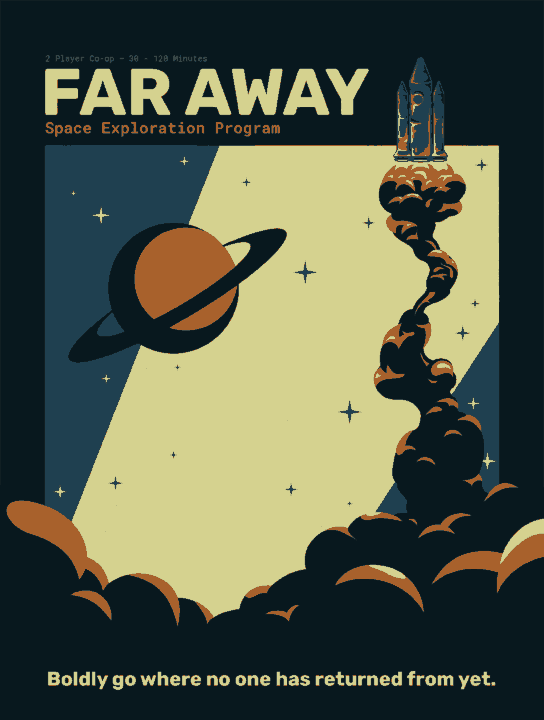
If you’ve ever wanted to be lost in space with a friend you can’t actually talk to, this review is for you. Far Away isn’t just a board game—it’s a wild co-op where you and your buddy, armed with some hope and questionable decision making, get tossed onto alien planets to complete missions and, you know, try really hard not to be eaten by space monsters. I’ve played this with my regular gaming crew, and I can tell you: things get messy, hilarious, and sometimes deeply tragic (RIP to all our bug-eyed explorers). Buckle up as I share just how Far Away will mess with your friendships and your patience—in the best way possible.
How It Plays
Setting up
Lay out the modular map tiles like some mad scientist, pick your brave (soon-to-be-lost) explorers, sort the mission cards, and dump a pile of weird supplies nearby. Give each player their own little ship and character sheet. Oh, and don’t forget the monster deck—no one ever does, except once when Tom hid it under his nachos.
Gameplay
Players start together, then wander off on their own. You can’t talk once separated, so plan wisely or expect pure mayhem. Explore tiles, gather resources, avoid (or become) monster chow, and try not to run out of food. Events pop up and aliens show up at the worst times—RIP, Barry.
Winning the game
You win if both explorers survive and complete the mission goals. If one of you bites the dust or you flub the objectives, you all lose. Teamwork matters, even if you can’t actually work as a team 90% of the time!
Want to know more? Read our extensive strategy guide for Far Away.
How ‘Far Away’ Redefines Co-op Gameplay and Player Interaction
Let me tell you, if you ever want to test a friendship, try playing Far Away. But not for the reasons you might think! This game flips the co-op script so hard, you might get whiplash. Most co-ops have you chattering away, strategizing together like a group of caffeine-fueled chess masters. In Far Away, though, you and your pal are two lonely astronauts who can’t talk once you wander out of earshot. It’s like the universe’s worst game of Marco Polo. I’ve never missed my friend’s annoying puns so much in my life.
Here’s how it goes: At the start of each round you can plan together, plotting the most brilliant strategies you can imagine. But as soon as you start exploring, you’re cut off. Suddenly, you’re relying on earlier conversations, wild guesses, and, if you’re me, the hope that your buddy remembers not to poke the alien wildlife. This forced separation makes every move tense and meaningful. It also makes the rare moments when you reunite so sweet you could write a space opera about it.
Unlike some co-ops (looking at you, games with alpha player syndrome), Far Away makes it impossible for one player to boss the other around. The design genuinely forces teamwork but without letting anyone take over—unless you’re a mind reader, in which case, can I borrow that skill?
Don’t get me wrong—sometimes the silence leads to confusion and accidental facehugger attacks, but isn’t that just another day in space? Next, let’s blast off into the galaxy of Far Away’s theme and world-building, where even the planets seem to have personality.
Lost in Space: Far Away’s Wildly Weird World
Right out of the box, Far Away throws you into a strange, wonderful universe. If you’ve ever wanted to send unqualified explorers to unknown planets (while hoping nobody eats anything poisonous), you’re in luck! The theme in Far Away isn’t just skin deep—it’s like a flavor explosion in a bag of astronaut ice cream. The game drips with personality from the moment you see those cartoony, doom-faced explorers on the player mats. Every mission feels like a new episode of a bizarre sci-fi show, one where things always go sideways, but at least you’ll get a funny story out of it.
The world-building is top notch. Each planet you land on in Far Away feels unique, thanks to a stack of colorful tiles and seriously creative creature cards. One time, my buddy and I ran into a slithering mushroom thing that burped spores whenever anyone got too close. (We named him Steve. Steve was not friendly.) The creatures aren’t just window dressing, either—they have motives, moods, and sometimes, a real knack for ruining your plans in hilarious ways. The story snippets and event cards help sprinkle even more chaos and humor into your doomed missions.
If you love games where the world feels alive, Far Away sucks you in deeper with every turn—often with a tentacle or five. Next up, get ready: we’re about to tackle just how tough it is to survive in this wacky cosmos with a peek at the Difficulty and learning curve!
Difficulty and Learning Curve: Boldly Stumbling Where No One Has Stumbled Before
Far Away is not the kind of game you pop open after eating pizza, half-watching a movie, and expect to win. If you try, you might just end up building a shelter out of rulebooks while your partner gets eaten by a bug the size of a minivan (yep, happened to us—RIP Greg).
The game’s difficulty gave me a headache in a good way. It forces you to actually, you know, strategize. Missions don’t mess around, and you can’t just wing it. Between resource management, environmental disasters, and the ever-present dread of being stranded on a planet with a snarky AI, players are always one misstep away from disaster. And you have to make decisions without chatting, which adds another spicy layer of torturous fun.
The learning curve for Far Away does have grumpy moments. The rulebook reads like it was written by a committee of cryptic aliens. My first play took two hours longer because we spent half the game looking up rules every turn. But, once you’ve managed to wrestle those rules into your brain, things get much smoother. The complexity rewards you, though. I found myself bragging about simple successes like finding food or not dying—stuff that feels earned, not handed out like candy on Halloween.
So, Far Away will absolutely punish your mistakes, but it makes small victories taste so much sweeter. Up next: I’ll explore whether this game keeps bringing you back for more, or if its missions wear out faster than my patience with Greg’s dice rolls!
Endless Planets: Replayability and Mission Variety in Far Away
Let’s talk about what keeps me coming back to Far Away: that sweet, sweet replayability. This game packs a pile of missions, and every single one tosses you into totally new, delightfully weird situations. One mission had me chasing after alien chickens in a radioactive swamp. Another day, I was trying to survive a planet where basically everything wanted to spit poison at me. There’s never a dull moment and no two missions ever feel the same.
Far Away is not just about beating the game—it’s about surviving the ride. Each mission brings new goals, new dangers, and the random planet generator makes each play feel like unwrapping a mystery meat sandwich. Sometimes you bite in and it’s not what you expected, but that’s half the fun. The galaxy is huge and there are a ton of event cards and alien critters that will keep your table talking (or, well, awkwardly miming, thanks to the no-talking rule) for ages.
If you’re like me and you get bored with games after a couple of plays, Far Away just won’t let you off that easy. There’s always re-play value, since you never know which wild curveball the universe will throw next. Variety’s the name of the game—and sometimes the name of the weird alien you just met.
So, do I recommend Far Away? If you want adventure that never quits and missions that don’t repeat, yeah—I say strap in and blast off!
Conclusion
Far Away stands out as a wild, weird, and sometimes lonely co-op adventure. The split-up partnership keeps every turn fresh, and the alien world is as strange as my Aunt Linda’s mystery casserole. If you like tough missions and wild stories, you’re in for a treat. The rulebook is a bit much the first time, but once you get the hang of it, Far Away offers endless replayability and real moments of panic and laughter. If you hate luck-based nonsense and crave a game with fair, tough choices, this one’s worth a look. That’s all from me—good luck out there, explorers! This wraps up my review of Far Away.