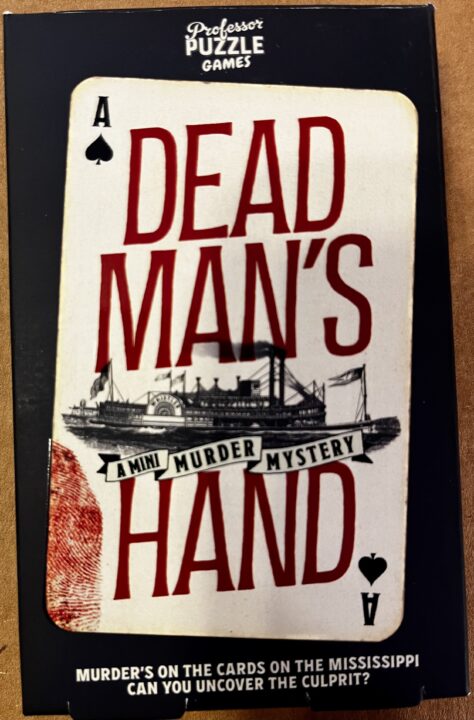

Picture this: It’s a Friday night, your friends are ready for some chaos, and someone shouts, “Let’s play that cowboy card game!” Welcome to my review of Dead Man’s Hand, a game that’s been tossed around my table like a shot of cheap whiskey. Over several rowdy plays, I wrangled cards, bluffed my socks off, and saw more double-crosses than a spaghetti western. But does it live up to the wild fun the cover promises, or did my posse and I end up wishing we’d gone for a root canal instead? Time to show my cards and see if this one’s quick on the draw—or just a misfire.
How It Plays
Setting up
First, grab your posse and shuffle up the deck. Deal each player their hand of cards and hand out character boards. Place the scenery and tokens on the table as if you were laying out a saloon for a shootout. Everyone picks their gang and gets their starting resources. Easy, right?
Gameplay
Each turn, you’ll play action cards from your hand and try to outsmart, outshoot, or out-cheat your rivals. You move your minis around the table, duck behind barrels, and maybe even flip a table if things get real hairy. Players alternate activating their gang members, taking cover, and firing shots. Watch your health and bullets, because getting caught in the open can end your evening early!
Winning the Game
Dead Man’s Hand is all about being the last gang standing. If your rivals are all pushing up daisies (well, cardboard daisies), you win! Sometimes, certain scenarios or victory points count too, but mostly, survive longer than your friends and you’ll be the legend of the table—at least until next game night.
Want to know more? Read our extensive strategy guide for Dead Man’s Hand.
How Dead Man’s Hand Keeps the Table Moving: Gameplay Mechanics and Flow
If you’ve ever wanted to feel like a wild west outlaw without the risk of actual prison time, Dead Man’s Hand is your ticket. The game gets you gun-slinging with cards, not bullets, and let me tell you, it’s a heck of a showdown. Gameplay in Dead Man’s Hand is all about quick-fire turns and keeping everyone on their toes. You start with a gang, and each of your desperadoes gets to do things like move, shoot, and occasionally duck behind a barrel like their life depends on it (which, to be fair, it does).
The core mechanic in Dead Man’s Hand is its card-based action system. You don’t just move and shoot – you need to play the right cards to do anything useful. It’s not like those games where you spend half an hour planning only for someone to blow everything up with a lucky dice roll (I still haven’t forgiven Gary for that game of Risk in 2018). Your cards decide who acts first, who gets caught flat-footed, and sometimes who bites the dust. This system keeps things brisk. No analysis paralysis here – if you stop too long to think, someone will probably throw a peanut at your head out of boredom.
Every round feels like a standoff, and the tension is delicious. If your group is anything like mine, you’ll spend half the game laughing, the other half muttering ‘I knew you were going to do that!’ So, now that we’ve shot the breeze about mechanics, let’s see whether skill or luck is calling the shots in Dead Man’s Hand.
Skill vs. Luck: Who Really Calls the Shots in Dead Man’s Hand?
If you’ve ever played Dead Man’s Hand, you’ve probably had at least one moment when your flawless strategy got curb-stomped by a lucky draw. It happened to me in my second game: I had a bandit in perfect position, my plan was airtight, but then my buddy flips the cards and, voila, my gunslinger gets ventilated by a last-minute Queen. To be fair, this is a game about shootouts, not chess. But still, I found myself grumbling about fate.
So, is Dead Man’s Hand a fair showdown of skill, or just a deck of wild luck? Honestly, it’s a bit of both. You have to make tough calls every turn—cover or shoot, retreat or hustle up close. That kind of decision-making rewards smart play. On the other hand, the random card draws for initiative and events can throw a silver horseshoe at your plans. But unlike some games where luck steamrolls the table, Dead Man’s Hand makes you feel like you could’ve done something different. My group noticed that the best player usually wins, but not always—sometimes the cards just hate you.
If you’re the type who throws their hat when luck goes sideways, Dead Man’s Hand might leave you with a bare head. But if you like a game where fortunes can shift faster than a cowboy with a grudge, you’ll probably be grinning. Next up, let’s have a good long squint at the game’s components and art—grab your tiny magnifying glass and prepare for judgment!
Dead Man’s Hand: Quality of Components and Art
Alright, let’s talk about the tactile stuff—Dead Man’s Hand is no slouch in the looks department. When I first cracked open the box with my usual group (yes, including Steve who never shuffles properly), we all gave an approving nod. The cards are thick enough that even my friend Anna, who shuffles like she’s kneading dough, didn’t manage to bend any corners after three games. That’s a minor miracle in our group.
The artwork is hands-down one of the best bits. You get these gritty, comic-book style illustrations that scream “Wild West.” Expect to see more mustaches than a hipster coffee shop, and every character looks like they’ve got a story or at least a tragic backstory involving a lost goldmine. The artist clearly knows how to set a mood. Even the action cards have flair—a few times someone paused just to show off a card before playing it.
The tokens (if you get an edition with them) are chunky and satisfying to toss onto the table, and the box insert actually fits everything back in, which is a unicorn in board game land. I would’ve liked linen-finished cards for extra durability, but that’s just me being picky after too many game nights fueled by greasy pizza and buttery popcorn.
In short: Dead Man’s Hand looks and feels like a game that wants to be played, not just admired on a shelf. Up next, let’s see if it keeps us coming back to the table or just swooning over the art—’cause if replay value was a duel, would Dead Man’s Hand leave us standing?
How Often Will You Be Pulling Dead Man’s Hand Off the Shelf?
When it comes to replay value, Dead Man’s Hand surprised me more than the time I found a Twix in my winter coat from last year. This game’s got a knack for making every showdown feel fresh. Thanks to a bunch of different scenarios and gang types, your shootouts can swing from a tense back-alley duel to a full-blown barroom brawl. Even after a few plays, my group kept saying, “Let’s go one more round.” And trust me, my friends usually have the attention span of goldfish in a disco.
The player interaction here is as loud as a cowboy boots tap-dancing contest. You’ll bluff, threaten, and sometimes just flat out beg your friends not to shoot you in the back. Every card you play can throw a wrench in someone’s plan, which means you can’t just sit quietly and hope for the best. The table talk gets wild, and nobody’s safe from a little friendly smack-talk. I saw my pal Pete try to talk his way out of a sticky spot only to be double-crossed faster than you can say “snake oil.”
If you want a game that keeps your group talking, thinking, and plotting against each other, Dead Man’s Hand delivers. There’s real replay value, because no two games feel quite the same, and the interaction pulls everyone in. Would I recommend it? If you like your board games with a side of drama and banter, this one absolutely belongs on your shelf—with or without a hidden Twix.
Conclusion
Well, partner, that’s a wrap on my review of Dead Man’s Hand. The game’s got style, fast play, and lots of out-loud table banter. I love how the cards look, and things stay tense from start to finish. Still, luck can mess up your grand plans and leave you feeling like a tumbleweed. If you hate random swings, you might want to steer clear. But for groups who enjoy a bit of chaos and cowboy showdowns, it’s a hoot every time. Thanks for riding along—now go shuffle up and try not to get shot in the back!