
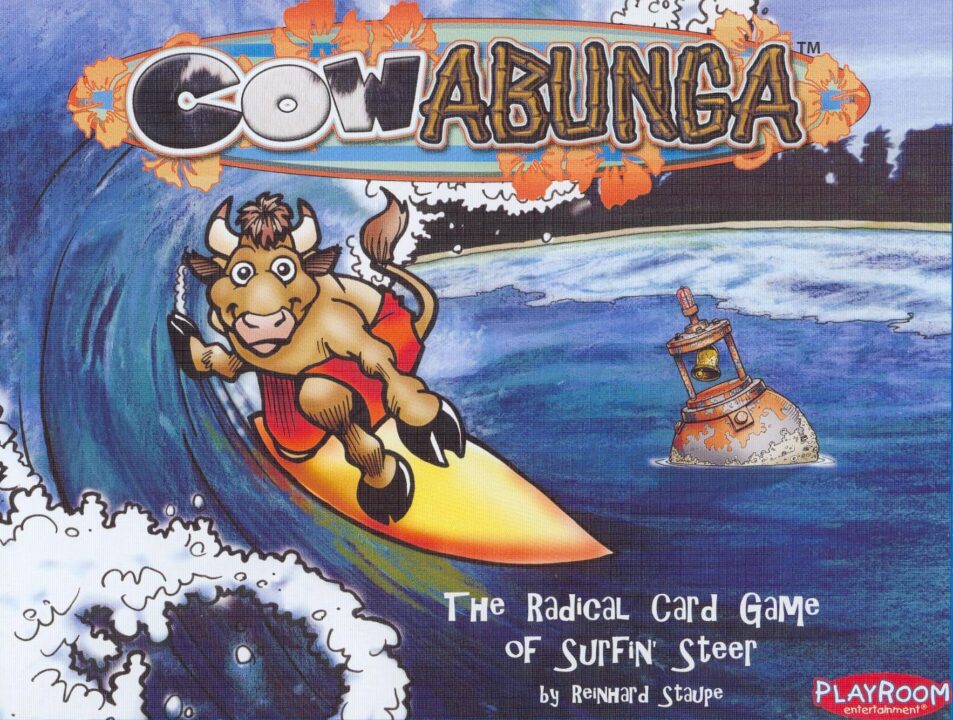
If you ever wondered what it feels like to ride the chaotic waves of a party game, you’re in the right spot. I’ll cover the rules, player shenanigans, and why this game is both a blast and a little bit of a roulette wheel. Let’s see if it’s worth your shelf space!
How It Plays
Setting up
First, lay out the surfboard cards in the center. Give each player a hand of cow cards (make sure everyone gets the right number – the rules have a handy chart, but we just counted because who needs math at a party anyway). Put the wave tokens within easy reach.
Gameplay
On your turn, play a cow card on a surfboard—remember, matching numbers is good, but sometimes you gotta risk it for a gnarlier wave. Grab a wave token if you complete a set, but watch out, because the next player might wipe you out by breaking your streak. You’ll bluff, you’ll guess, and you’ll sometimes completely mess up—like I did, trying to play a 6 on a 5-card pile (don’t be like me).
Winning the Game
The first player to collect enough wave tokens (check the rules for the magic number, or just pick a number that sounds fair if you’re impatient like us) is the Cowabunga champ. Expect a lot of cheering, groaning, and maybe a suspiciously long bathroom break from whoever just lost the lead.
Want to know more? Read our extensive strategy guide for Cowabunga.
Game Mechanics and Rule Clarity in Cowabunga
Let me tell you, if you ever wanted to pretend you’re a surfing cow then Cowabunga is your ticket to ride – or, in this case, to wipe out. The first thing I noticed about Cowabunga is how simple the mechanics are. I picked it up in about five minutes, which is faster than my grandma can make a cup of tea. Each player gets a hand of cards with different surf actions and your goal is to ride the wave without crashing, all while trying to mess up your opponents’ plans. It’s a fast-paced, real-time kind of game, which means you need to stay sharp, or you’ll be eating sand (or hay?).
The rules are on the lighter side. The rulebook fits on one page, and not in tiny print either. If you can read instructions on a shampoo bottle, you can handle Cowabunga. The rules could honestly use a few extra examples, especially if you play with people who love to find loopholes. (Shoutout to my mate Pete, the master of technicalities.)
The mechanics are smooth but not especially deep. If you’re looking for layers of strategy, this isn’t it. But if you want a quick, silly challenge where everyone has a shot to win, Cowabunga works. Just be aware luck plays a big part, which is a turn-off for some. Overall, the game mechanics work for what the game is trying to be— a light and silly card game.
Up next, let’s see if Cowabunga brings the cow-petitive spirit out of your herd, as we get into Player interaction and competition!
Surfing the Waves of Player Interaction and Competition in Cowabunga
If you want a game where people stare silently at their boards, Cowabunga is not for you. This is a game that shouts, laughs, and (very occasionally) snorts in triumph. Every session I play, someone is always calling someone else out for pulling a sneaky move or taking a risk that pays off big time. Cowabunga’s cards don’t just affect you—they let you mess with your friends, which, let’s face it, is the best part of game night.
One evening, my friend Mel tried to play it cool, but then slipped me a gnarly card that made me lose my entire “wave”. My revenge? An even gnarlier move two turns later. The game does a great job of keeping everyone involved. You get to watch each other closely and even cheer—or groan—when someone bites it hard. There’s also a bit of bluffing, which means you can’t trust anyone, not even your grandma. (If you win against your grandma, you totally get bragging rights, by the way.)
The competition in Cowabunga is friendly, but fierce enough that people care about winning. You’ll see shifting alliances and playful banter, especially if someone starts to get ahead. This game is at its best with a full table, and works for all ages—just be ready for a few sore losers and the need to nag everyone to focus.
Next up, I’ll talk about how Cowabunga rides the line between luck and skill, or if luck wipes out your strategy like a rogue wave!
Luck vs Skill: Who’s Really Cowabunga’s Boss?
Alright, let’s settle an age-old question for game nights everywhere: does Cowabunga reward clever thinking or does it just let Lady Luck surf away with your hopes and dreams? Spoiler: it leans heavier on luck than skill, and I’ll tell you why.
Most turns in Cowabunga are built on card draws and unpredictable events. The cards you get deal out your fate like a deck of wild surfboards and wobbly hooves. Sure, you can try to play smart and guess what others might do, but if the deck is not in your favor, your cow is tumbling into the ocean, no matter how zen you are about it.
Now, that’s not to say there’s zero skill. You can make some tactical choices, like when to play certain cards or how to bluff your friends into a false sense of security. But let’s be honest—Cowabunga’s fun comes from its unpredictable, surf’s-up chaos more than any deep strategy. If you like your board games to make your brain sweat, you might get a sunburn here instead.
Next up, grab your sunscreen and board shorts, because we’ll talk about Cowabunga’s replay value and how long it keeps the party rolling before you bail out for snacks.
How Many Times Can You Cowabunga?
When it comes to replay value, Cowabunga delivers some real party energy. Now, this is not a game that promises grand, sweeping narratives or epic campaigns. Instead, it’s more like the board game version of a popcorn flick. Easy to set up, quick to play, and just as quick to pack up when snacks run low.
I ran a session with my usual game crew—our record was four rounds in a single night. No one complained about boredom, but nobody said “Let’s play it six more times!” either. The randomness means each round feels new, but the simple mechanics also mean you won’t discover any hidden layers on your fifth go. Basically, Cowabunga is a good time in small doses. Too many games and you might start hearing moans about wanting to play something with a bit more depth. (Looking at you, Matt, who still holds a grudge because he got unlucky three times in a row.)
Game length is a strong point. Each match of Cowabunga takes about fifteen minutes, unless your mates get distracted by snack runs or telling stories about well, cows. This makes it a perfect filler game for game nights, or for those times when your brain isn’t up for heavy thinking after a long day. Even with a full table there’s no risk of the night dragging on like that one Monopoly session from 2011.
If you want a fast, hilarious game that never overstays its welcome, Cowabunga is worth a spot on your shelf. Just don’t expect it to be the star of every show. I recommend it for quick fun, not for depth or serious rivalry. Moo-ve it into your collection if that sounds good to you!
Conclusion
Cowabunga is the kind of game you pull out when you want quick laughs and don’t mind if Lady Luck is running the show. The rules are clear, the action is fast, and you’re guaranteed to see your friends make some wild moves (and wild faces). Sure, if you want deep strategy or a serious challenge, this isn’t your beach. But if you enjoy unpredictable fun and silly competition, you’ll find plenty to smile about. Just don’t blame me if your winning streak washes away in a single round—hey, it’s called Cowabunga for a reason! That wraps up my review. Now go hang ten, or at least hang onto your cards!