
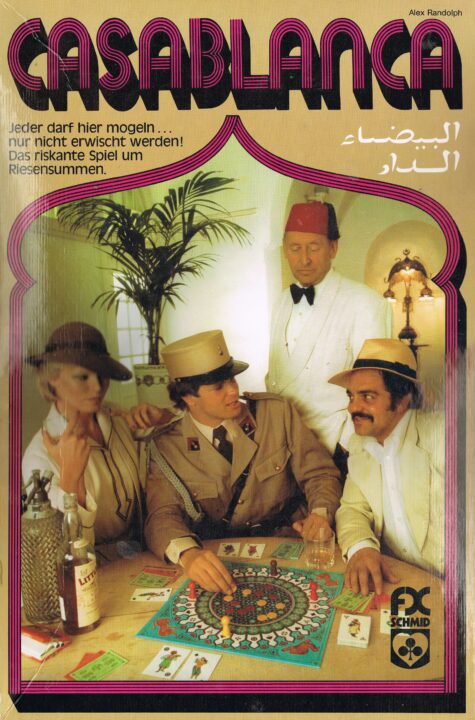
Picture this: you’re hunched over a table with your best friends, channeling your inner movie star, and arguing over crates of – well, let’s call it ‘valuable cargo’ for now. Welcome to my review of Casablanca, a game that serves up film noir drama, tense negotiations, and plenty of backstabbing, all from the safety of your living room. I’ve played this one more than a few times with my usual crowd, so I’m ready to spill all the beans: the juicy moments, the clever tricks, and the bits that made me want to flip the table (but didn’t, because I can’t afford more broken coffee mugs). Read on if you want to know just how fun (and fair) Casablanca really gets around the table!
How It Plays
Setting up
First, toss the big board on the table and make sure everyone has a comfy seat. Place the resource tokens, money, and characters near the board. Each player grabs their own player marker and a starting stash of coins. Shuffle the item cards and deal a few to each player. Get ready for lots of side-eye and suspicious looks.
Gameplay
On your turn, you’ll talk, scheme, swap, and probably make promises you can’t keep. Players trade goods and information, bribe characters, and try to get their hands on prized items. There’s bluffing, sweet-talking, and plenty of sudden betrayals.
Winning the game
The game ends when the escape plane arrives (someone triggers the end round). Whoever snags the most valuable combination of items and cash when the dust settles wins. Bonus glory if you do it with a Humphrey Bogart impression. Just don’t blame me if you lose because you trusted someone—you were warned!
Want to know more? Read our extensive strategy guide for Casablanca.
Theme and Movie Magic: Does the Board Game ‘Casablanca’ Do the Classic Justice?
As someone who once tried to re-enact the famous “Here’s looking at you, kid” scene with a stale baguette, I can confidently say I know a little about what gives the movie Casablanca its spark. The question on my mind: Does the game actually capture the classic film’s feel, or is it just a bunch of cardboard with a trench coat?
First off, the artwork sets the mood. Moody blacks and classic whites, with the kind of font choice that whispers old Hollywood in your ear. Cards are peppered with references: the Blue Parrot, Rick’s Café, and even that mysterious Vichy water bottle (it’s there, I checked). My friend Shelly, who has seen the movie at least twenty times, squealed when she found out you can secretly switch allegiances mid-game. It’s dramatic, it’s mysterious… and it keeps everyone eyeing each other suspiciously over the edge of their coffee mugs. Just like in the film, trust is in short supply.
But, the real twist? The storylines you create depend on who you play and what choices you make. Sometimes people choose loyalty. Sometimes, betrayal. You may not get Humphrey Bogart’s voice, but there’s a real sense that your choices matter in the story that unfolds. It’s probably the closest you’ll get to living out a night at Rick’s, minus the smokey air and existential angst.
Trust me, the Casablanca theme is not glued on—it’s stitched right into the gameplay. Next, I’ll spill the beans on just how many friendships ended (and maybe started!) during our sessions with the game’s wild player interaction and sneaky negotiation.
Player Interaction and Nail-Biting Negotiation in Casablanca
Alright, let’s talk about one of the juiciest parts of Casablanca: its non-stop player interaction and cutthroat negotiation. I brought this to my weekly game night and—oh boy—peace did not last long. This is a game that takes your friendships, shakes them by the shoulders, and says, “Good luck trusting each other ever again!”
The heart of Casablanca beats in the deals you make (or break). Every round, you’re haggling for secret information, swapping influence, or maybe just bribing your way out of a jam. My friend Ben, who always claims he’s an honest trader, turned into a sneaky backstabber faster than you can say, “Here’s looking at you, kid!”
Negotiations often start friendly—lots of, “We can both win here”—but it quickly turns into a slapstick circus of promises and betrayals. I’ve seen players try to form shaky alliances, only for them to collapse the second someone smells an advantage. Usually, it’s followed by dramatic sighs and some popcorn flying across the table.
This level of interaction really keeps everyone on their toes. Even when it’s not your turn, you’ve got to watch who’s whispering what. If you like keeping secrets and bluffing your pals, Casablanca will give you plenty of stories to retell. The only downside? If you play with someone who hates negotiation or gets sore about being lied to, things might get awkward faster than a weird family reunion.
But how long does all this banter take, and will you want to play again and again? Grab your fedora, because that mystery’s up next in our section on Game Length and Replay Value!
How Long Does Casablanca Last and Will You Play Again?
When I first sat down to play Casablanca, I expected a quick, breezy game. Instead, I ended up having enough time for three cups of tea, two snacks, and several arguments with my friend over the moral definition of “double-crossing.” The game usually clocks in at around 60 to 90 minutes, but let me warn you: if your group loves to debate every negotiation, things can get wild and stretch longer. At one point, we spent 20 minutes deciding if someone should get a pint or a passport. It was tense, but also a blast!
Replay value in Casablanca is pretty solid. Every session has a fresh vibe, thanks to different player tactics and those unpredictable item cards. The game’s many paths to victory mean that you can be cunning or charming, or just flat-out bribey, and your opponents always keep you guessing. But for those who like super heavy games with hundreds of possibilities, Casablanca might not have quite the depth you’re after. It’s got plenty of replay fun, but it’s more about stories and clever moments than big brain math equations.
The only slight downside is that if you play with the same group over and over, people can start to develop “meta” strategies. Suddenly, everyone is suspicious of your every move. But honestly, that just makes the next game even funnier!
Up next: I’ll spill the beans on whether Casablanca is all about the luck of the draw, or if you can actually outsmart your rivals. Hint: this is where things get spicy like a Casablanca market stall!
Is Casablanca More Brains or Just Rolling the Dice?
Alright, let’s clear the smoke from the gin-joint air: how much of your fate in Casablanca is luck, and how much is pure strategic brilliance? If you’re like me, you want to win because you outsmarted your friends—not because you pulled the right card at the right time (although, let’s be honest, that’s a nice feeling too).
In Casablanca, the game walks a thin line. The main actions let you scheme, trade, and bluff your way to victory. So, if you can talk your way out of a paper bag (I cannot, by the way), you might actually win. The heart of the game is player negotiation, so it’s less about rolling dice and more about rolling with the punches. However, luck does poke its nose in through cards and some event triggers. While I never felt my fate was totally sealed by chance, there were a few moments where someone got exactly the card they needed and suddenly shot into the lead.
Strategy wins most games. If you listen, adapt, and keep your wits, you will do fine. But don’t expect a chess-like puzzle. If you hate randomness entirely, this may not be the nightclub for you. If, however, you love a good mix of plotting and a pinch of unpredictability, you’ll be shouting, “Play it again!” (Sorry. Had to.)
Do I recommend Casablanca? If you like negotiation, wheeling, dealing, and don’t mind a dash of luck, I absolutely recommend giving Casablanca a spot on your shelf.
Conclusion
Alright, that wraps up my Casablanca review! This game really pulls you into a smoky world of sly deals and double-crosses, just like the old film. I loved how every turn had me sweating over a trade offer or plotting my next move, sometimes cursing my pals and sometimes cursing myself. The game shines when you play with friends who like a bit of friendly betrayal and banter. Just be aware, there’s a dash of luck mixed in with the scheming—enough to keep you laughing, sometimes groaning, but mostly engaged.
Casablanca is a solid pick if you want a game full of player drama and laughs, though it isn’t the one for you if you can’t stand games where luck sometimes turns the tables. For fans of negotiation and movie themes, this one deserves a shot. Thanks for sticking with me—until next time, may your friendships survive game night!