
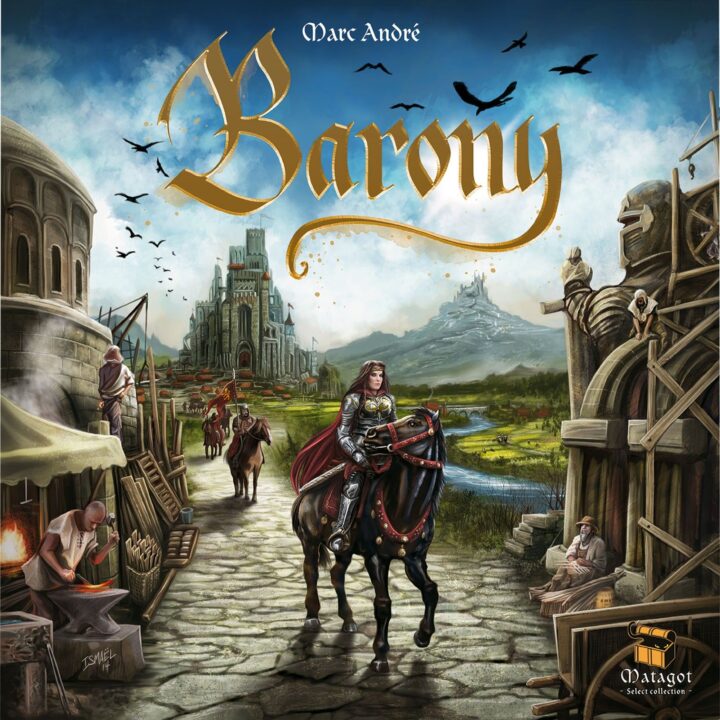
You ever feel like conquering the world, one tiny plastic knight at a time, without having to worry about dice ruining your master plan? Well, you’re in the right place. Welcome to my review of Barony, the game that lets you scheme, expand, and backstab your friends in a medieval land—all without a lucky roll in sight.
How It Plays
Setting up
Lay out the map tiles and toss out your little wooden cities, towers, and knights. Each player picks a color and grabs their matching pieces. Plop your starting cities at the map edges, because nobody trusts their neighbors here.
Gameplay
On your turn, pick two actions. You can move your knights, build villages or cities, upgrade your pieces, or go raiding (aka, politely wrecking someone else’s day). Everyone is out for land and resources. There’s lots of sneaky blocking and some good old-fashioned “I-saw-you-coming” moves.
Winning the game
Score points by turning your resources into noble titles. The first player to reach the highest noble rank grabs the win. That’s right—only one person gets to brag with their pinky raised. No dice, no luck—so if you lose, you can only blame your strategy (or that one friend who always blocks you).
Want to know more? Read our extensive strategy guide for Barony.
Strategic Muscle: The Game Mechanics and Player Interaction in Barony
Okay, let’s talk mechanics. It all sounds straightforward until you realize every move you make is a public invitation for your friends to ruin your plans. Seriously. I had my heart set on a pretty stretch of forests until Ashley (known fun-wrecker) parked her knights right on my path.
In Barony, each action matters, and you only get one per turn. No multi-tasking or busywork here. There’s none of that dice-chucking nonsense, so luck is barely a footnote. This means you can actually blame (or praise) yourself for your wins and losses. Point to Jamie for taking total credit for some dazzling losses! The tension comes from watching your opponents and predicting their every move. This isn’t one of those games where you can nap through other people’s turns. You’ll watch, plot, and probably mutter things under your breath like I did.
Interaction stays high from start to finish. Blocking is almost an Olympic sport in this game. People can steal your land, cut you off, or just plain annoy you. That makes every game feel like a little soap opera. If your group likes “peaceful” games, run far away. But if you enjoy a bit of sabotage and clever moves, this one shines.
So you’ve got smart moves, direct competition, and not an ounce of randomness. Next up: let’s see if Barony looks as good as it plays, as I spill the tea on its components and design choices!
Barony’s Components and Visual Design: Where Classy Meets Sturdy
Not for rule confusion, but because the board looked straight-up classy. The hex tiles give you this ever-changing medieval map that feels both new and familiar, like déjà vu at a renaissance fair. They lock together neatly, which means no accidental earthquakes when someone reaches for snacks. I appreciate that more than I’d like to admit.
The pieces themselves? Oh man, those little wooden knights and castles are a joy. They look and feel solid—not like those cheap plastic dudes from games you find in bargain bins at weird gas stations. Plus, each player gets their own color. No one fights over who is red here! I once dropped a whole handful of my pieces onto the floor, and not a single one lost a head or a horse. Sturdy stuff.
The artwork on the tiles is all moody medieval—lots of green forests, blue lakes, and brown fields. It isn’t flashy, but it tells you exactly what you need to know. Nothing feels crowded or hard to see, which is great when you’re trying to spot that one spot your sneaky friend is about to steal. Also, the wooden resource tokens are fun to stack, even if that’s not in the official rules (don’t tell the designer).
Honestly, Barony’s components make setting up as enjoyable as playing.
Replayability and Learning Curve in Barony
The rules seemed simple, but then my friend Kelly outsmarted me in under 15 minutes. If you like a quick learning curve where you jump in, make mistakes, and get better, Barony hits the spot. The rulebook is short, but every play feels a bit different since the map tiles change how you approach the game. I swear, last week my buddy Rob managed to box me in with forests and ruined my night—and my kingdom.
Replayability is high with Barony. No two games have the same layout, and your sneaky friends will always keep you guessing. I’ve played with my usual group of four, and every time, someone tries a new tactic. Sometimes it works, sometimes it ends in tears and popcorn getting thrown. Unlike games that drag for hours, Barony moves at a brisk pace, so if you get crushed, you just reset and start plotting your revenge. It’s never a slog, and there’s always a sense that if you just play one more round, you’ll finally get it right.
If you enjoy games where you can come back and try to outfox your friends with a new plan, Barony delivers. The game rewards cleverness more than memorizing rules, so new players don’t feel totally lost after a round or two. Next up, I’ll spill the beans on whether your victories in Barony are hard-earned or just down to cosmic dice luck—get ready for the battle of skill versus chance!
Barony: When Strategy Reigns and Luck Takes a Nap
Alright, let’s talk straight. If you want a game where luck decides your fate, Barony will leave you high and dry—like a dice that forgot how to roll. Barony rewards sharp planning, ruthless moves, and just a dash of table talk. You win by being clever, not by flipping a magic coin.
The choices in Barony feel meaningful. Build a city here, block a rival there—every decision can haunt or help you. Well, they noticed. Hard. My plans crumbled like a stale biscuit. That’s the beauty of Barony: It forces brains to battle, not dice.
Randomness? Hardly any. Maybe if your cat jumps on the table and knocks over the board, but the rules themselves keep luck out of the picture. You can see what everyone’s doing, so you can plan and scheme like a medieval mastermind. This makes Barony perfect for folks who’d rather win (or lose) by outwitting their pals instead of praying for lucky draws. If a game night ends in grumbling, it’s because someone outplayed you, not because they got a lucky break.
My advice? If you want skill to matter most and you’re tired of blaming the dice for your defeat, Barony’s calling your name. If you prefer games where anything can happen thanks to a lucky flip, this might feel too fair. But for strategy fans like me, I give it four and a half castles out of five. Just don’t expect your lucky socks to help you here.
Conclusion
Barony really stands out among strategy games. The smart, no-luck mechanics mean you win by planning, not by rolling lucky dice. We found ourselves plotting moves and alliances for hours—and then arguing about it for hours more. If you want a game where your brain matters more than your lucky socks, Barony is a solid pick. But if you want drama from dice or wild surprises, you might feel left out. I give it a strong thumbs up for thinkers. That wraps up my review—now go conquer your friends!