
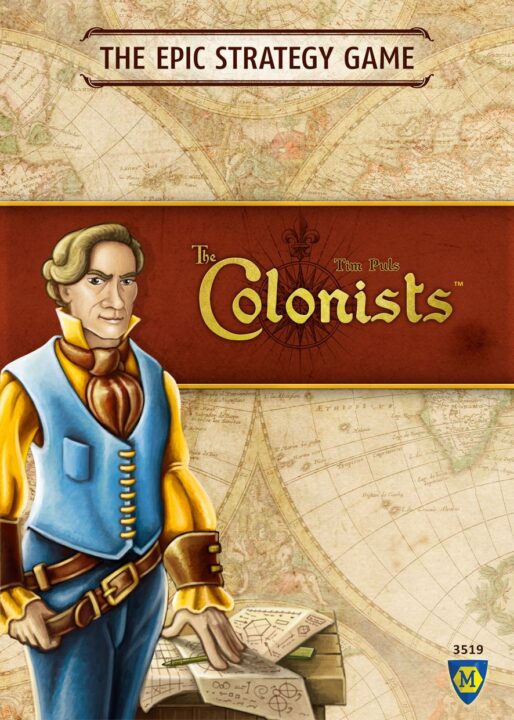
Welcome to my review of The Colonists! Grab your snacks and call your most patient friends—this one’s a beast. I sat down with my game group to test our wits (and our bladders) through hours of strategy, very little luck, and what felt like moving a small forest of wooden pieces across the table. Is it worth carving out a whole day? Am I still friends with those who lost? Read on to find out!
How It Plays
Setting up
First, get ready to spread out. The Colonists needs a big table—no, bigger. Lay out the modular board, pile up resource tiles, and hand out player boards. Everyone picks a color, gets their cute little workers, and stares in awe at just how much cardboard lives in this box. Don’t forget the many, many tokens. (Pro tip: use snack bowls or risk token avalanches.)
Gameplay
Players take turns moving their mayor meeple around the board, collecting resources, and building up their colonies. Each round (called an “Era”) adds new tiles and bigger decisions. It’s all about planning ahead, getting the right upgrades, and making sure your workers are busy. Random chance hardly shows up here, so blame only yourself when your entire colony forgets to harvest potatoes for three years straight.
Winning the game
After all Eras finish—or your snacks run out—everyone counts up their victory points. These come from buildings, upgrades, and your colony’s population. The player with the most points wins and gets bragging rights for surviving the board game equivalent of a work week!
Want to know more? Read our extensive strategy guide for The Colonists.
How Long is Too Long? The Colonists and Commitment Issues
If you’re the kind of person who thinks a “long game” means two episodes of your favorite sitcom back to back, then The Colonists might make your head spin. Let me tell you from experience: this is not just a board game, it’s almost a lifestyle choice. The rulebook suggests you can play a single era for about 45-60 minutes, but if you want to play the full four eras, you better clear your weekend. Or, if you’re one of those folks who just can’t say no to “one more round,” maybe your whole week.
It’s not just about having time, though—it’s about holding focus. The Colonists isn’t the kind of game you can play halfheartedly while scrolling through your phone. Every turn matters. I remember the look on my buddy Sam’s face when he realized, two hours in, that he still had two eras to go. Priceless. If you don’t have patient friends or a tolerant partner, you might be playing solo, which The Colonists does support, by the way. For the seriously committed (or mildly obsessed), there’s even a campaign mode.
If you crave a night-long epic or want to see how your city evolves over time, this is a treat. If you want quick snacks, you may want to keep looking.
Stay tuned, because next I’m tearing into one of my favorite game debates—strategy versus luck! Will The Colonists pass my picky test? Grab your dice, but maybe don’t roll yet…
Strategy vs Luck: How Much Control Do You Have in The Colonists?
Let’s talk about the grand tug-of-war between strategy and luck in The Colonists. No dice here, my friend. If you mess up, it’s on you, not on some badly-behaving cube of plastic.
The heart of The Colonists is resource management and careful planning. I still remember watching my friend Steve plan two years ahead, only to forget he needed another worker to pull off his big move. He blamed his lack of coffee, but we all knew—this game demands brainpower. Every decision can bite you later, whether it’s what you build, who you hire, or even the path your pawn shuffles around the board. Plans gone wrong? That’s usually a planning disaster, not rotten luck.
There is a dash of luck with the setup tiles and development cards, but they won’t win or lose the game for you. You can’t blame the board gods if your colony falls apart. Instead, you’ll need to adapt your plans and, sometimes, quietly curse your last turn’s choices instead of the fates.
If you like controlling your own destiny—or at least getting the blame for your epic failures—The Colonists will make you feel like a real city planner, not a gambler at a dodgy casino. And now, let’s check out if the game looks as good as it thinks it plays, as we march on to component quality and table presence – will it drop jaws, or just drop cardboard all over your floor?
Component Quality and Table Presence in The Colonists
When you open up The Colonists, you’re not just unboxing a board game—you’re unloading a moving truck straight into your living room. Seriously, there are so many pieces. The cardboard tiles come in thick, sturdy sheets and feel satisfying to punch out. I’ve seen board game tokens so flimsy they make a saltine cracker look solid, but The Colonists’ components can survive accidental elbow sweeps, pets, and even that one friend who handles everything like a gorilla at feeding time (looking at you, Mark).
The wooden components are a joy. With little meeples, resource cubes, and buildings, the table ends up looking like a bustling (and colorful) city. Some people said it looked like Sim City meets Lego Duplo. I’ll admit, setting up the board takes as long as an Ikea build, but when it’s all laid out, the board screams, “Look at me! I’m important!” I actually left it out on the dining table for a week just to admire it. It’s a showstopper for board game nights, and folks walking by will definitely ask, “What’s this monster?”
I do wish the player boards were a bit bigger. My sausage fingers felt like King Kong trying to arrange a dollhouse, and sometimes I’d send pieces flying like a small-scale tornado. Still, it’s a minor complaint considering how beautiful the finished setup looks.
But all that eye-candy means nothing if you can’t keep the experience fresh—or handle different player counts.
Replayability and Scaling with Players in The Colonists
When it comes to replayability, The Colonists feels like a bottomless pit. I don’t mean that in a scary, oh-no-what-have-I-done way. I mean there are just a bajillion (okay, maybe four) eras, a ton of tiles, and endless ways to mess up your future plans. You can try a different strategy each time, and it still throws curveballs your way. With all the options for setup and path-finding, every game scratches that ‘let me do it better next time’ itch. I’ve played with the same group more than once, and our games never played out the same way twice—except I always forget to feed my people. You’d think I’d learn.
Scaling with players is another beast entirely. I’ll be honest: The Colonists can get a bit slow with more than three. It’s not that the game breaks, but my patience almost did. The downtime between turns grows when you add more people, especially if you’re playing with those folks who think for ages before moving their little worker. Two players is the sweet spot for me, as things zip along and you can keep a friendly rivalry going. Four players felt like running a marathon at a snail’s pace. Oh, and if you’re trying to teach everyone? Good luck—you’ll need a snack and maybe a pillow.
So, would I recommend The Colonists? If you have the stamina (and some good snacks), and you like long, thoughtful games with a side of friendship-testing moments, then yes! Just don’t say I didn’t warn you about those marathon four-player sessions.
Conclusion
So, that’s The Colonists! If you like super long, brain-burning games packed with chunky pieces, planning, and not much luck, this is your jam. It shines brightest with two players, has replay value for days, and the table looks like a bustling cardboard metropolis when you set it up. But beware: you need friends who won’t bail after hour two. If you want action and chaos, look elsewhere. Otherwise, block off your weekend and get building! This wraps up my review—now if you’ll excuse me, I need a nap and maybe some new friends who still talk to me.