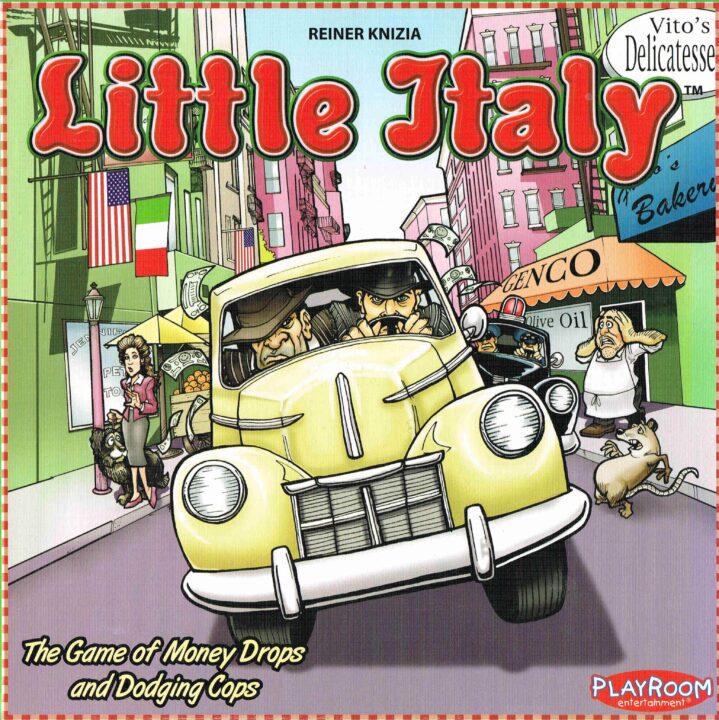

If you love board games where you have to outsmart friends and maybe ruin a friendship or two along the way, then you’re in the right place! This is my review of Little Italy—a game I’ve put on my table more times than I probably should admit. I’ll walk you through what makes it a fun ride (and where it gets a little bumpy) so you’ll know if it’s worth adding to your own game shelf. Grab a snack, maybe some cannoli, and let’s get this show on the road!
How It Plays
Setting up
First, place the Little Italy board in the center of your table. Each player grabs a matching set of delivery cars and tokens. Shuffle the pizza order cards and deal some out face down. Place the remaining cards as a draw pile. Pop all the pizzas and pepperonis out of their punchboards. If you’re me, you’ll eat real pizza while you do this.
Gameplay
On your turn, move your cars around the board to deliver pizzas to different neighborhoods. The goal is to complete your pizza orders before anyone else. But watch out! Other players can block your routes, steal your deliveries, or just be general troublemakers. You’ll need to plan ahead, but a bit of luck helps—especially when you draw a good order card!
Winning the Game
The first player to finish all their pizza orders wins and is crowned ‘Big Cheese’ for the night. If you tie, the player with the most pepperoni tokens wins. In my group, this usually leads to loud arguments about who counts as ‘finished’ and if pineapple should be legal.
Want to know more? Read our extensive strategy guide for Little Italy.
Gameplay Flow and Player Interaction in Little Italy
Alright, let’s talk about how it feels to actually sit down and play Little Italy with your pals (or rivals, depending on how competitive your grandma gets). Out of the box, Little Italy tosses you straight into a turf war where you’re hustling your neighborhood crew from spot to spot, grabbing up deliveries and outwitting your sneaky opponents. Every player has their own tiny fleet of cars that they move around the board, trying to snag jobs and avoid trouble from other players. If this sounds a bit like ‘Boardwalk Empire for Beginners’—yep, you’re on the right track.
The whole thing runs on turns, but they don’t drag. The gameplay flow is brisk, especially once everyone knows the rules. Nothing grinds the fun to a halt, unless someone mistakes the cannoli token for a snack (guilty, once). Choices are simple, mostly: move your car, pick up or drop off a delivery, maybe block someone’s path just to watch them groan. Believe me, there are plenty of ‘Oh no you didn’t!’ moments around the table. The board’s tight layout stokes a lot of bumping and blocking. If you hate games where you just do your thing in a corner and nobody bothers you, Little Italy is not that game. You’re in each other’s way. A lot.
Interactions are sharp and direct, and there’s enough room for some sneaky strategies. If you like a little trash talk and eye-rolling with your pizza, you’ll feel right at home here. Next, let’s see if luck or skill rules these mean streets…
Luck vs Skill: Who’s Really Calling the Shots in Little Italy?
If you have ever flipped a table because of a roll of the dice, welcome. Pull up a chair. In my many playthroughs of Little Italy, I’ve put the luck vs skill balance through its paces. Let’s get this out there: this game is not Monopoly, but you won’t feel like a grandmaster chess champion either.
Skill comes in the form of picking the best routes, making alliances, and sometimes blocking your friends just to see their faces turn sour. That’s the joy, really—outsmarting people you care about and watching them groan as you take their pizza delivery money. Good planning helps, and if you pay attention, you can spot who’s hoarding cash and who’s just pretending. I’ve found myself staring down my best mate, both of us trying to read each other’s intentions, and it’s a blast.
But—and here’s the big slice—luck does sneak in more than I like. There are dice rolls and card draws that can flip your fortunes without any warning. One game, I spent twenty minutes building an empire, only to get clobbered by a single unlucky card on my last turn. My cries of despair still echo around the kitchen. I’d say about 60% skill, 40% luck. If tilted scales annoy you, just be warned. If you don’t mind a few surprises, you’ll still have fun—just don’t expect to win on skill alone every time.
Alright, so enough about fate and flukes—let’s talk about what you’re actually playing with. Next up is the all-important verdict on Little Italy’s components and artwork, and trust me, my eyes have things to say.
Little Italy Board Game: Component & Artwork Quality Review
Let’s talk about the bits and pieces that make Little Italy pop on your table! Nothing kills mobster mood faster than sloppy cards or faded paper money, so I paid extra attention here. The box itself is a chunky little number—sturdy enough that my cat tried to sleep in it (10/10 for feline coziness). Inside, the cardboard tokens feel solid and chunky. I tossed one across the room in a heated argument over who controlled Brooklyn and it survived without a dent. That’s what I call gangster-grade durability.
The artwork just oozes 1920s charm, like you’ve stepped into a cartoon version of The Godfather. Every character card has its own personality; our group spent an embarrassing amount of time trying out Italian accents for every new face. (Spoiler: mine were all terrible). The city map board is clear, colorful, and you’ll always know exactly where your turf wars are going down. The icons are clean and obvious, so not even my half-distracted cousin could get confused, and that guy once got lost in his own driveway.
If you love games with some table presence, Little Italy fits the bill. It’s not deluxe but it doesn’t look or feel cheap, either. No smudgy printing or warped tiles in my copy, and I’ve got a keen eye for that stuff after too many budget buys gone wrong. Everything here sets the right atmosphere for backstabbing and bribery…in the nicest way possible.
Buckle up, because next we’re spilling the tomato sauce on replayability with different groups—and trust me, it gets spicy.
Is Little Italy Fun With Any Group? Let’s Talk Replayability!
Little Italy has a table presence that screams, “Let’s make some mischief!” But the real test is: will it keep your gaming group coming back for more? Can it handle your spicy aunt, your cousin who hates board games, and your friend from work who still doesn’t know what a meeple is?
I wrangled three very different sets of friends for this test. First, my family game night crew. They’re boisterous and competitive—kind of like the board game equivalent of a wrestling match with pasta sauce. Little Italy brought out the scheming side in even my mom. She blocked my delivery route (again!) and then laughed so hard her glasses fogged up. My family loved the blocking, stealing, and light strategy. It was a hit.
Next, my serious gamer friends. The ones who think about the statistical odds of drawing a card while eating chips. For them, Little Italy felt a bit light and luck-driven. They still had fun, but asked for something “meatier” next time—hey, not every game night needs to be a brain burner!
Lastly, I played with a bunch of board game newbies. They picked up Little Italy fast. The rules are easy, and the playtime isn’t epic, so it never overstayed its welcome. No one got bored, and the table talk was wild.
Bottom line: Little Italy shines when you’re looking for a quick, interactive, and slightly chaotic experience. Is it for everyone, every week? Maybe not. But I’d recommend it for families and casual groups looking for laughs and light drama. Bring snacks. You’ll thank me.
Conclusion
Well, there you have it folks! Little Italy is a light, fun game perfect for families and those who love a little bit of chaos. The game shines with charming art and sturdy pieces, which even survived my cousin Vinny spilling soda on them (don’t worry, I made him mop it up). The player interaction keeps everyone laughing and plotting, but luck can sometimes spoil your carefully crafted plans. It’s not for the strategy-obsessed, but if you want quick, lively games with friends or family, it’ll hit the spot. If you hate games where a lucky roll ruins your day, be warned! That wraps up my review—thanks for joining me in Little Italy. Now, if you’ll excuse me, I need to figure out how to get tomato sauce out of my rulebook.