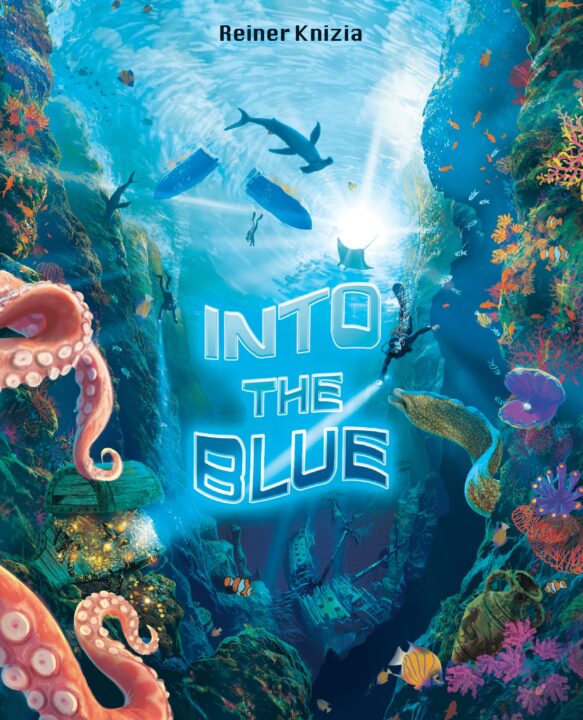

Welcome to my review of Into the Blue! If you love chucking dice, claiming treasure, and arguing about who gets which shiny gem, this game might just call your name. I’ve played it with my friends (and survived the shouting matches), so I’ve got the goods on what works, what’ll make you toss the rulebook, and whether it’s worth your board game bucks. Buckle up for a quick, honest, and hopefully entertaining review!
How It Plays
Setting Up
Open the box and hand every player a set of tokens in their color. Place the ocean board in the middle. Put the shiny pearl tokens in their spots and shuffle the treasure chests. Make sure everyone can reach the dice or prepare for a night of yelling, “Hey, whose turn is it?”
Gameplay
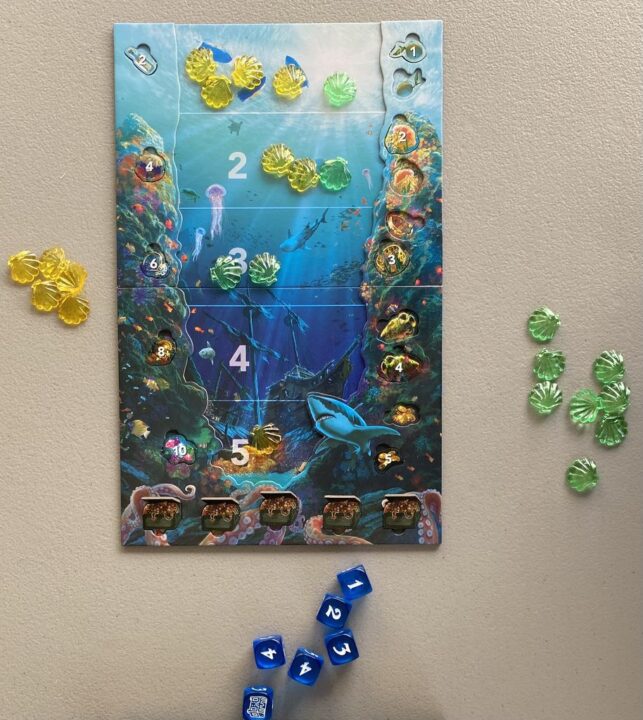
On your turn, you roll all six dice. Pick a number and keep any dice showing that number, setting them aside. Roll the rest. You do this until you can’t keep going, have run out of dice, or have locked in enough to claim a space. You place your token on the matching row of the board. The more rows you claim, the better your shot at winning, but sometimes the dice only roll like they want to see you lose. Some spaces even have treasure chests or pearls to grab if you land there.
Winning the Game
When all the spaces fill up, the game ends. Add up your points for claimed spaces and goodies. Whoever has the most points wins. At this point, you should try not to gloat—unless you’re playing with my group, in which case you must stand up and do a victory dance.
Want to know more? Read our extensive strategy guide for Into the Blue.
Game Mechanics and Player Interaction in Into the Blue
So, picture this: It’s Friday night, pizza boxes scattered everywhere, my cat judging us from the corner, and my friends and I are huddled around the table with Into the Blue. Right away, it’s clear that the game keeps things simple but lively. The core mechanic is actually a push-your-luck dice roll, but don’t worry—you won’t just sit there cursing your dice (well, not all the time). You chuck dice, try to claim treasure, and press ahead on the board as deep as your courage (or foolishness) takes you. I love that all the choices happen out loud. You’ll hear plenty of groans and wild cheers. Interaction is high, because everyone gets real nosy about where you place your tokens. At one point, my mate Dave tried to fake me out by acting extra excited about a bad position just so I wouldn’t go for a better spot. Spoilers: I still went for it and lost.
The board itself is straightforward, with numbered depths, so you never get lost (unlike me at Ikea). Every turn, you face the choice: Do I keep rolling, or play it safe? Other players totally egg you on, because if you mess up, you open up juicy spots for them to nab. There’s also a sneaky aspect where you can block someone’s progress, and that’s always good for drama. The rules say you can only have one token per depth, but trust me, the competition is fierce over those treasures. It’s a great mix of chaos and actual tactics, though I wish there was a little less gloating from the winners (I’m looking at you, Emma).
Next up, let’s talk about the real test: does Into the Blue balance luck and strategy, or are the dice just out to get us all?
Luck vs. Strategy: Can You Outsmart the Dice in Into the Blue?
Let’s be real: when I first cracked open Into the Blue, I hoped for at least a 70/30 split between brainpower and luck. You know, enough randomness to keep things spicy, but not so much that my mate Dave could win while still thinking about what pizza he wants. Sadly (or maybe, for you chaos gremlins, happily) this is one of those games where Lady Luck sits at the table with you—and sometimes dumps your strategic plans straight into the bin.
The core action? Roll six dice. Re-roll what you hate. Try to snag treasures before anyone else. Your choices do matter: you can push your luck, freeze some dice, or play safe and quietly claim the smaller trinkets. But here’s the kicker—no matter how clever you play, a single bad roll can tank your round. I’ve watched in horror as my grand plan for the deep-sea crown was destroyed by a streak of ones. Meanwhile, Lucy, who’d been quoting SpongeBob all night, managed to scoop up the best treasures with dice rolls blessed by Poseidon himself.
So yes, you can strategize. You can bluff, threaten, and beg your dice for mercy. But at the end of the day, Into the Blue is mostly about rolling well. If you need a game where the best tactician always wins, you’ll get salty here—like, ocean-level salty. But if you’re in the mood for a fast, silly game that brings everyone to the same level (and maybe makes you erupt into giggles when a plan goes wrong), it still earns a spot on the shelf.
Now if you think luck sounds fun, wait ‘til we see how often you actually want to play this thing—and how long it can possibly last. On to replay value and game length!
Replay Value and Game Length in Into the Blue: Is it Worth Another Go?
If you ask me, one of the best things about a board game night is the chance to squeeze in a few rounds before someone gets hangry. With Into the Blue, you won’t have to worry about anyone going on a snack rampage between turns. Each game lasts maybe 20 to 30 minutes—just enough time for some friendly ribbing before the inevitable rematch.
When it comes to replay value, Into the Blue brings a mixed bag. I’ve played this game with my friends several times, and let me tell you, the short game length means you can get a bunch of plays in a single evening. Sometimes we even set up a mini tournament (winner gets to choose which pizza toppings to ban for the night). The game doesn’t really change much from round to round—there’s not a heap of strategic depth hiding under those waves, but it’s quick, breezy, and nobody storms off to sulk if they lose.
However, I will say that after four or five games, my group started to look at each other like, “So, should we move on to something meatier?” Into the Blue feels best as a warmup or a filler between bigger games, and it shines brightest with people who enjoy light competition, quick laughs, and not taking things too seriously. Don’t expect it to stay fresh night after night, but if you need a low-stress opener or a change of pace, it delivers.
Right, enough about replay value! Next up, I’ll be spilling the (navy) beans on the component quality and artwork of Into the Blue—so brace yourself for a tidal wave of opinions!
Into the Blue: Components and Art – Worth Rolling For?
Let’s talk about the look and feel of Into the Blue. I’ve played games with cardboard so thin you could sneeze a hole through it, but thankfully, this isn’t one of those games. The dice are chunky and have a good roll to them. That’s important; you can’t have a game about rolling dice and then chuck some plastic sugar cubes at me. The dice designs are clear and easy to read, even for my friend Steve, who still struggles with the number six.
The tokens and the main board impressed me more than I expected. The ocean theme is simple yet cheerful, with a cartoonish charm. I didn’t once mistake a shell for a pearl, which is saying something, since I’m the kind of person who once mistook a Monopoly house for a piece of broccoli (don’t ask). Everything feels sturdy enough to survive a few heated losses—no paper cuts or bent corners after multiple nights of play.
The artwork pops on the table, and helps the game stand out from the sea of boring dice games lurking in my closet. It doesn’t win any art awards, but my group unanimously agreed the style put us in a lighter mood, even when luck wasn’t on our side.
Should you pick up Into the Blue for its looks alone? Maybe not, unless you’re really into aquatic vibes or collect dice that actually feel nice in the hand. But if you want a game that looks good and can handle some rough and tumble play, I say: sure, go for it! Just don’t expect it to win any beauty pageants against the big boys.
Conclusion
Alright, that’s a wrap on my Into the Blue review! If you love rolling dice, shouting at your friends (in a friendly way), and quick games, this one’s for you. The pieces look great, the game plays fast, and it’s easy to teach even to your uncle who still thinks “board games are for kids.” Just know that luck rules the waves here, so don’t expect to plan out clever strategies. It’s a fine filler, not a main event. If you’re looking for something chill and colorful to break up a game night, grab Into the Blue and prepare for some satisfying dice clacks—just don’t blame me when your lucky friend keeps winning! Thanks for reading, now go roll some sixes.