
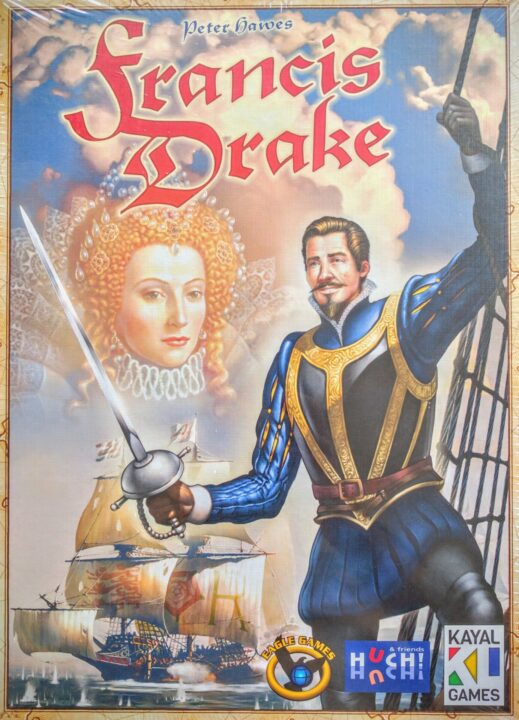
Ready to buckle some actual swash? This is my review of a board game that lets you gather supplies, recruit rough-and-tumble sailors, and sail into the high-stakes world of 16th century privateering. Grab your spyglass and some rum (not included in the box), because all hands are on deck for an honest look at this pirate adventure!
How It Plays
Setting up
First, pick a color and grab your crew of tokens and ships. Lay out the main board. Toss out barrels, guns, and supplies in their city spots. Shuffle mission tokens, and deal everyone a secret goal. Set up the Spanish fort tiles, your ships, and get ready for some pirate action.
Gameplay
Everyone takes turns sending their pawns through the bustling Port of Plymouth, grabbing supplies, crew, and secret missions as they go. There’s only one catch: you can never go back. So if you sprint for the rum, you might miss out on a cannon for your ship. When the port phase ends, the real fun starts. Players set sail to raid Spanish forts and towns, using their hard-earned stuff. There’s bluffing, risky plans, and plenty of tense standoffs around the table. You have to outthink your friends if you want the best loot!
Winning the game
After three rounds of sailing, plundering, and pretending you’re basically Johnny Depp, everyone counts points from the loot, missions, and leftover supplies. The player with the most points wins. Try not to gloat—unless you want to play solo next time.
Want to know more? Read our extensive strategy guide for Francis Drake.
Theme and Historical Immersion in Francis Drake: Setting Sail for Authenticity
Francis Drake does not just plop you onto a pirate ship and call it a day. No, this game puts a feather in your hat and a monkey on your shoulder, then shoves you straight into the cutthroat world of 16th-century privateering. Sure, I still can’t grow a beard worthy of the historical Sir Francis, but I felt pretty heroic all the same.
The game’s board is basically a treasure map brought to life. You’ve got Plymouth at one end, and the Caribbean at the other, with so many places to plunder, I had to resist saying “Arrr!” after every move. The art on the board and cards tries really hard to make you feel like a real explorer. I caught myself squinting at the little Spanish galleons, plotting routes like I actually knew what I was doing. (Spoiler: I did not.
You can see the designers went all in on history here. The supplies you take—cannons, crew, even lanterns—make you feel like your success actually depends on some smart planning, not just luck. And the cast of historical characters you bump into, from Elizabethan nobles to the ever-present Spanish defenders, adds some real flavor. My mate Andy, who once fell asleep during a pirate movie, even stayed awake until the end of the game. If that’s not immersive, I don’t know what is.
The only thing I wished for? Maybe a little more personality in the events and crew. It’s immersive, for sure, but sometimes things felt a tad too orderly for piracy. Anyway, buckle up your boots and ready your map, because next we’re hoisting the sails to talk about planning your moves with Francis Drake’s action selection mechanics!
Planning Your Adventure: The Action Selection Process in Francis Drake
Francis Drake has one of the most interesting planning systems I’ve ever played. Each turn starts with a walk down Plymouth High Street (yes, really), where your pirate meeple can shop for all sorts of things: crew, guns, supplies, and those all-important secret missions. But here’s the catch—once you go past a space, you can’t go back. This turns what should be a jolly stroll into a stress-filled race with your friends. I still remember my mate Pete shouting “You greedy pirate!” after I grabbed the last cannon early just to make him sweat. Sorry Pete. Sort of.
Choosing your actions in Francis Drake is a whole event by itself. There’s this delicious tension as you keep an eye on what the others are doing. Do you grab extra crew now, or gamble that nobody else will take the last barrel of rum? Sometimes I get so wrapped up trying to second-guess everyone that I end up missing what I actually need. That’s when you know a game’s planning phase really works.
Then all the planning comes together for your trip across the high seas. The resources you picked earlier decide what you can attack, trade, or awkwardly avoid. It rewards thinking ahead, but doesn’t feel like you’re solving a math problem. There’s always interaction and the occasional bit of sabotage. I like that players are forced to balance what’s needed now with what might help later, but the tension is always fair.
But what about Lady Luck’s role on these voyages? Well, batten down the hatches, because next, we’ll see if Francis Drake is a game of cunning—or a roll of the dice!
Francis Drake: Luck, Skill, and the Great Balancing Act
Let’s talk about luck and skill in Francis Drake, because nothing makes me grumpier than a game that lets Lady Luck stomp all over my brilliant plans.
Skill comes in strong during the planning phase. Players have to decide which resources, crew, and ships to take before they set sail. Even better, you have to guess what your friends are planning, because if you skip ahead on the street, you can’t go back and grab something you missed. It’s deliciously mean in the best way, and you’ll kick yourself for being too greedy (trust me, I did).
Once you set sail, the game does throw in a pinch of luck. There are secret mission tokens and cubes that get drawn for each location, and sometimes your grand attack plan can get dunked into the harbor by a bad draw. Also, combat uses numbered strength discs, so your enemies can surprise you with a sneaky high number, but at least you have some control since the discs are limited.
Still, luck never totally takes over. You can plan for most scenarios, and even losses feel like your own fault 70% of the time. That’s a charming balance for me—not random enough to make me flip the table, but just risky enough to keep me sweating.
If you’re wondering whether Francis Drake holds up over repeat plays and how much you can mess with your friends, batten down the hatches—next, we’ll talk replayability and player interaction!
Why Francis Drake Keeps Hitting the Table: Replayability and Player Drama
I’ve played Francis Drake with the same bunch of scallywags and, honestly, it never feels like the same game twice. Even my friend Ben, who usually grumbles when he loses, says it’s always fresh. There’s something about the way you prep for your big journey—different supplies, new crew, and always, always that one jerk who grabs the last cannon before you.
The replayability comes down to choices. Every game, you’ll tweak your plan. Maybe you go heavy on guns. Maybe you stock up on secret missions. There’s this push-your-luck in how far you go down the street grabbing resources, because once you pass something, you can’t go back. I’ve seen more than one salty argument about who went too far or who’s hoarding all the barrels of rum.
And the player interaction is chef’s kiss. You’re all racing to hit the best ports, and let me tell you, it gets spicy. You have to watch what everyone else is doing. One friend usually pretends to go for gold, only to double back for a fat pile of silver. I’ve never trusted him since.
Francis Drake isn’t just about your own plan—it’s about reading everyone else and sometimes, messing them up. That keeps us coming back. No two games are the same, no two table arguments either. If you like friendly competition with just enough backstabbing to keep your friendships interesting, this is an easy recommend from me. Set sail and prepare for some shenanigans!
Conclusion
Alright, this wraps up my review of Francis Drake! If you like your board games with clever planning, lots of interaction, and a pirate hat’s worth of drama, this one nails it. The theme feels rich, the decisions matter, and every player can control their fate—just not their dice rolls. I wish some event cards had a little more spice, but overall, Francis Drake sails ahead of most games in its genre. If you want skill over luck and enjoy a good race to the New World, put this on your table. Happy gaming, and thanks for reading!