
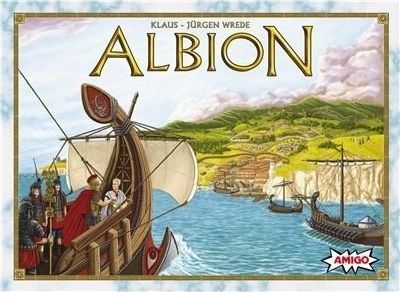
Albion turns Roman settlement in Britain into a race to build a functioning economy and convert it into three fully developed settlements. Klaus-Jürgen Wrede’s design asks an appealing question: how much infrastructure is enough before expansion becomes the better use of a turn? Its attraction is the connection between movement, production and construction, rather than a sequence of battles.
How It Plays
A turn offers two alternatives: move and build, or collect resources. Movement points can be divided between settlers and legionnaires; settlers then construct or improve buildings at their locations. Production turns supply the resources needed for later upgrades. Higher building levels require a wider range of resources, and building in occupied regions can involve tribute. Pict tokens introduce uncertainty around new construction. The race ends after a player completes three level-IV settlements, with one in a laurel-marked region; the round is finished before resolving the result.
The Decisions That Matter
The separation between producing and building gives every turn an opportunity cost. More production can support later upgrades, but collecting resources does not advance a settler that turn. Conversely, pushing across the map without adequate supplies can leave an expansion plan unfinished. This is the strongest reason to consider Albion: economic preparation and geographical position have to support the same objective.
Who It Suits
The designer lists two to four players, ages twelve and up, and about seventy-five minutes. That makes it a candidate for a planned strategy evening rather than a quick filler. Players who enjoy development races may appreciate its clear settlement objective. Those seeking a historical simulation or a primarily military contest should look closely at the economic emphasis first.
Verdict
Albion’s documented design offers a focused mix of resource planning and expansion. The two-action turn structure is easy to describe, although construction, tribute and Pict resolution deserve a careful rules read. It is most interesting for groups that want the pressure of deciding when to stop preparing and start finishing. Our recommendation rests on those design features; balance across player counts is not established here.
Rules and Further Reading
Albion rules and learning resources.